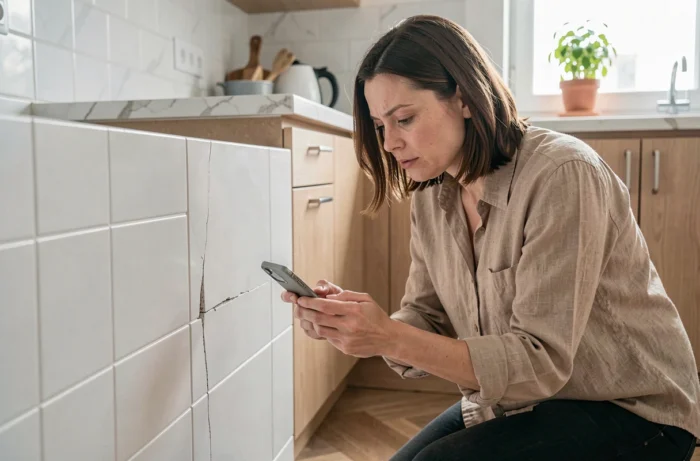
A traveler leaves the accommodation, and the inventory reveals a cracked coffee table and burn marks on the countertop. The host opens a claim, and a few days later, a notification appears on the traveler’s account with an amount to pay. This scenario, increasingly regulated by Airbnb, deserves a precise understanding of the rules to avoid ending up paying a questionable bill or, conversely, ignoring a legitimate request.
Tighter proof standards since April 2026: what changes for travelers
The April 2026 update of the damage protection terms has raised the bar for hosts filing a claim. Airbnb now requires unaltered and timestamped photos taken from multiple angles. Images generated or altered by artificial intelligence are explicitly rejected as admissible evidence.
For the traveler, this change has a direct consequence: poorly documented claims are less likely to succeed. If a host submits a reimbursement request accompanied by blurry photos, without timestamps or showing a single angle, it can be contested more effectively.
Airbnb clarified in its updated terms as of August 1, 2026, that the damage guarantee “is not an insurance contract” and “does not replace insurance.” The platform reserves the right to resolve a dispute without the usual rules of insurance law applying.
The issue of damages charged to Airbnb travelers therefore relies on a contractual framework specific to the platform, not on traditional insurance coverage.
Airbnb claim deadline: the 14-day rule and its trap
Most guides mention a 14-day deadline after departure for a host to submit a reimbursement request via the Resolution Center. This deadline exists, but it has an additional constraint that is rarely explained.
The claim must be submitted before the arrival of the next traveler, even if they arrive two days after your departure. If the host has back-to-back bookings and does not report anything before the next check-in, their claim loses credibility, or even becomes inadmissible.
As a traveler, this rule protects you. A host who charges you for damages three weeks after your stay, while another traveler has occupied the accommodation in the meantime, will struggle to prove that the damage came from you. This point can be relied upon during a dispute.
How to respond to a reimbursement request
When a host sends a request via the Resolution Center, the traveler has 24 hours to respond. Three options are available:
- Accept the amount if the damages are real and properly documented, which closes the case
- Propose a lower amount by justifying why (normal wear and tear, disproportionate amount compared to the damaged item)
- Reject the request if the evidence is insufficient or if the damages existed before arrival, in which case Airbnb intervenes as a mediator
Not responding within 24 hours does not mean automatic acceptance: Airbnb then takes over to review the case. Feedback varies on this point, but letting the deadline expire without reacting weakens your position.
Preventing Airbnb damage disputes before the stay
The best protection against abusive billing remains preventive documentation. We are talking about simple reflexes that take a few minutes upon arrival and departure.
Upon arrival: document the existing condition
Photograph the main rooms, fragile surfaces (countertop, table, floor), and any visible defects. Send these photos to the host via Airbnb messaging to create a timestamped record in the system. A message like “I note a scratch on the living room coffee table” is sufficient.
This approach creates evidence prior to the stay. If the host later attempts to charge for a pre-existing damage, the Airbnb conversation will serve as a reference.
Upon departure: the exit photo reflex
Before returning the keys or leaving the accommodation, do a quick walkthrough with your phone. Photograph the same areas as upon arrival. This visual symmetry allows for a comparison of the initial and final condition.
- Kitchen: countertop, appliances, dishes
- Living room: sofa, table, screen, floors
- Bathroom: fixtures, shower wall, seals
- Outside (if applicable): garden furniture, terrace
We are not talking about spending an hour inventorying everything. Five minutes and about ten pictures are enough to cover the at-risk areas.

Liability insurance and travel insurance: the safety net outside the platform
The Airbnb framework (AirCover) is not the only lever in case of a dispute. Your personal liability insurance can cover damages caused to a third party, including in a vacation rental. Most multi-risk home insurance contracts include this coverage.
Check your contract before leaving. Some insurances exclude damages caused in the context of a short-term rental, while others cover them without restriction. In the case of a significant claim (broken furniture, accidental water damage), reporting the incident to your insurer can prevent you from having to settle the entire amount via Airbnb.
For stays abroad, travel insurance with liability coverage offers an additional layer of protection. The AirCover program does not replace insurance, as Airbnb now explicitly states in its terms.
Charging for damages on Airbnb relies on a system of evidence, deadlines, and mediation that favors the prepared traveler. Photographing the accommodation upon arrival and departure, responding quickly to requests from the Resolution Center, and knowing the limits of the AirCover program are the three pillars of a stay without financial surprises.


