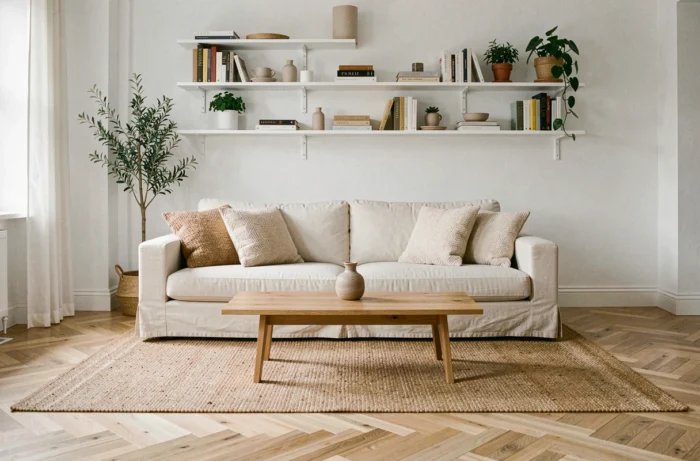
When you push open the door to a home design exhibition, the first instinct is often to take photos of the setups without knowing how to translate them into your own space. The gap between a showcase room and a modest-sized living area, with its constraints of light and storage, complicates the projection. Exhibitions like Home Expo allow you to touch the materials, test the configurations, and confront your desires with the reality of a coherent interior design.
Modular furniture: the concrete answer for small spaces
The gradual reduction of living spaces in both new and old homes has changed the game. We no longer look for a sofa just to sit on, but rather a storage ottoman that frees up a square meter of floor space. Foldable desks, extendable tables with built-in compartments, and reconfigurable shelves meet the same need.
What makes a difference at an exhibition is seeing these pieces of furniture in real situations. A foldable desk in a catalog seems clever. In reality, you discover whether the mechanism squeaks, if the depth is suitable for a screen, and if the locking holds up over time. Transitioning from visual to tactile is exactly what a visit to a show like home expo at Habitat Expo allows, where usage scenarios are staged room by room.
Multifunctional furniture is no longer a gadget but a structural necessity for today’s homes. Feedback varies on the durability of certain mechanisms, which is why it’s important to handle them before buying.
Color palettes for a sustainable interior: avoid shades already in decline
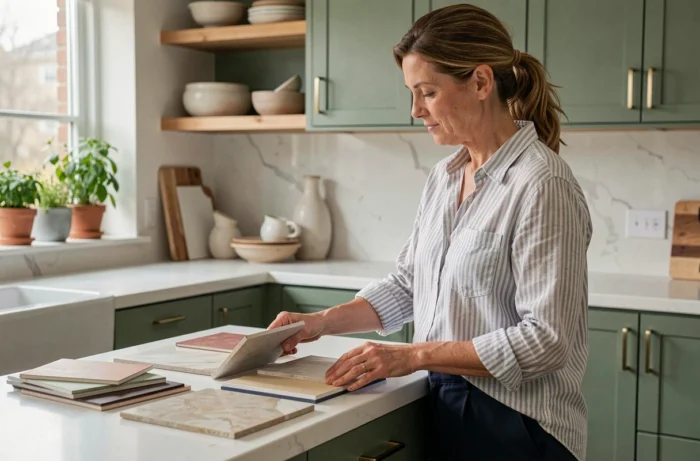
Color trends evolve faster than we think. The highly saturated shades that dominated a few years ago (duck blue, very bright sage green) are already losing ground in specialized publications by 2026. Instead, there is a return to earthy palettes and matte tones: ochre, muted terracotta, warm brown, sandy beige.
This shift is not trivial when completely redecorating a room. Repainting a living room costs time and money. Choosing a color that will be dated in two years means accepting to start over.
How to test a color before committing
At a home exhibition, exhibitors often present complete ambiance setups. You can compare an entire room in a matte earthy tone with another in a light satin finish. The lighting at the booth replicates realistic conditions, which helps assess the rendering better than a color chart at a hardware store.
Here are some concrete guidelines to help direct your palette choice:
- Warm matte tones (soft terracotta, rosy beige) absorb light and are suitable for rooms that are already well-lit naturally. In a north-facing living room, they can darken the space.
- Off-whites with yellow or pink undertones warm up a bedroom without visually closing it off, whereas pure white can appear cold.
- Dark woods (walnut, smoked oak) are making a strong comeback in furniture but require a light wall in return to avoid a cave-like effect.
Combining dark wood with a light wall remains the safest combination for an interior that won’t go out of style in two seasons.
Living room and bedroom decor: what exhibitors show that a website cannot
Interior decoration suffers from an online bias: photos are retouched, perspectives distorted, volumes flattered. A textured cushion looks identical to a smooth cushion on screen. The difference is felt by touch.
At an exhibition, you can evaluate the quality of an upholstery fabric, the weight of a light fixture, the flexibility of a blackout curtain. For the bedroom, it’s even more striking: the feel of bed linen or the density of a mattress topper cannot be guessed behind a screen.
The collected over time style rather than catalog decor
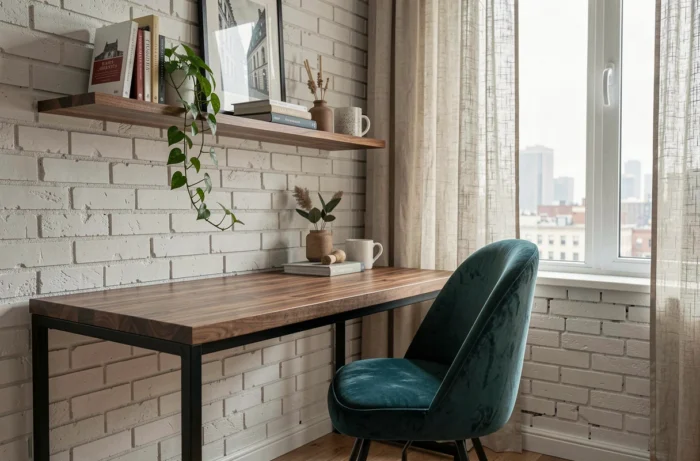
Decor publications in 2026 highlight a style that professionals call “collected over time.” The principle: mixing pieces from different eras and styles rather than buying a complete collection from a single retailer. A vintage armchair next to a contemporary table, a handmade vase on an industrial console.
This type of approach requires a discerning eye. This is where an exhibition becomes a learning ground. You observe how professional decorators juxtapose materials (raw linen, brushed metal, matte ceramics) and note what works visually.
Kitchen and bathroom: areas where mistakes are costly
Unlike a living room that can be rearranged by moving a few pieces of furniture, the kitchen and bathroom involve heavy renovations. Plumbing, electricity, waterproof finishes: a poor decision pays off for years.
At a home exhibition, you have access to kitchen designers and planners who showcase their work in real volume. You can open drawers, test soft-close systems, and check the height of a countertop in relation to your own body type.
For the bathroom, exhibitors often offer configurations for small spaces with walk-in showers, wall-mounted sinks, and built-in storage. Seeing these solutions assembled allows you to judge whether they fit your own room.
- In the kitchen, checking the ergonomics of the activity triangle (sink, stove, refrigerator) on a displayed model prevents discovering a circulation flaw after installation.
- For bathroom furniture, testing the moisture resistance of materials (melamine, laminate, treated solid wood) is done by placing your hand on it, not by reading a technical sheet.
- Recessed lighting for bathroom mirrors is better judged in real conditions than in photos, where the color temperature is often misleading.
The most successful home layout choices are rarely those made on a screen. Touching a material, opening a piece of furniture, comparing two finishes side by side in a full-size space transforms a vague idea into a mastered interior project. Home exhibitions provide precisely this direct access to solutions, professionals, and current decoration trends.