
Sizing a battery for a 3000W solar panel involves solving a multi-variable equation: storage capacity, cell technology, depth of discharge, and lifespan. Each of these variables affects the actual cost per kWh stored over time, and it is precisely this data that differentiates the options available on the market.
LFP Lithium, NMC Lithium, and Lead: Technical Comparison for 3000W Solar Battery
Three technologies dominate the residential storage market. Their performance gaps explain price differences that, when considered over the lifecycle, sometimes reverse the hierarchy.
| Criterion | Lead-acid (gel/AGM) | NMC Lithium | LiFePO4 Lithium (LFP) |
|---|---|---|---|
| Usable depth of discharge | About 50% | About 80% | About 80 to 90% |
| Estimated lifespan | Several years | Longer than lead | The highest of the three |
| Relative weight | The heaviest at equal capacity | Intermediate | Light |
| Thermal risk | Low | Moderate (possible thermal runaway) | Very low |
| Initial purchase price | The lowest | High | High, close to NMC |
Lead-acid batteries have the lowest entry price. However, their depth of discharge limited to about half of their nominal capacity requires a significantly higher gross capacity to achieve the same usable storage as lithium.
The choice of a suitable battery for a 3000w solar panel therefore depends less on the catalog price than on the actual cost per kWh effectively delivered over the entire lifespan of the system.
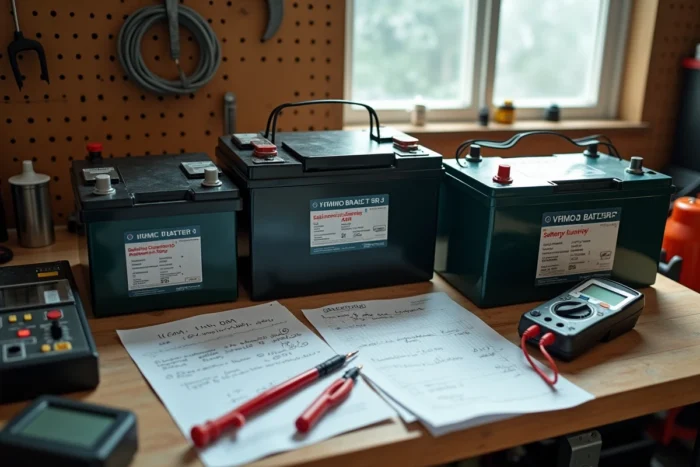
Storage Capacity in kWh: Calculating the Real Need for a 3 kWc Installation
A 3 kWc installation produces an average of between 10 and 15 kWh per day, depending on regional sunlight and the orientation of the panels. Not all of this production needs to be stored: only the surplus not consumed during the day justifies the investment in a battery.
Actual Surplus and Self-Consumption Rate
A household that consumes a significant portion of its production during the day (telecommuting, programmed heat pump, vehicle charging) generates less surplus than a household that is absent during the day. The surplus to be stored often varies between one-third and half of the daily production.
For a 3 kWc installation, professional guides generally recommend a battery capacity between 5 and 10 kWh. This sizing covers evening and night consumption without oversizing the system.
- A household with moderate nighttime consumption (lighting, refrigerator, internet box) will be at the lower end of the range, around 5 kWh usable.
- A household using a heat pump or hot water tank during off-peak hours will need to be closer to 8 to 10 kWh.
- Beyond 10 kWh for 3 kWc, the daily surplus generally is no longer sufficient to fill the battery, which degrades profitability.
Oversizing a battery means paying for storage that remains empty for most of the year. The right benchmark is to never exceed in kWh the average daily production of the installation.
Modular Battery and Smart Management: What Changes the Profitability Calculation
Typical content compares cell technologies and stops there. The reality of the market in 2024-2025 shows a deeper shift in logic: the residential battery is no longer a simple passive reservoir.
Modular Storage Expansion
Recent ranges like the Zendure SolarFlow Mix Series offer modular LiFePO4 batteries starting at 8 kWh and expandable up to 50 kWh of storage. The SolarFlow 3000 Mix AC+ model is explicitly sized for households consuming around 3,000 kWh per year, which is a typical 3 kWc installation profile.
This modularity allows for gradual investment: starting with a module suited to the current surplus, then adding capacity if usage evolves (electric vehicle, home extension).
Energy Management via Software and AI
These systems now integrate advanced software layers (mobile app, optimization algorithms) that automatically decide when to charge or discharge to maximize self-consumption and avoid free injection into the grid.
Zendure, for example, uses an AI called ZENKI that adjusts charge cycles based on weather forecasts and household consumption habits. This type of management increases the self-consumption rate without manual intervention, which directly translates into a faster return on investment.
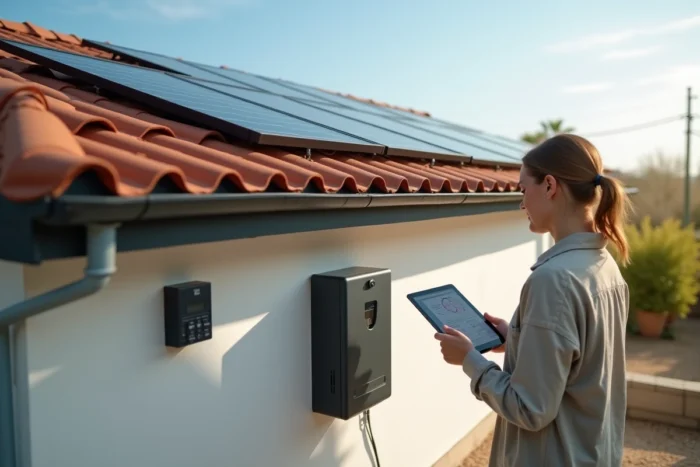
Depth of Discharge and Lifespan: Data That Affects the Real Price per kWh
Two batteries with the same nominal capacity can deliver very different amounts of energy over their lifespan. The depth of discharge (DoD) and the number of cycles are the parameters that determine the actual cost.
- A lead-acid battery discharged beyond 50% sees its lifespan drop rapidly. In practice, only half of the displayed capacity is actually usable.
- A LiFePO4 battery tolerates regular discharges of 80-90% of its nominal capacity, with a significantly higher number of cycles.
- The cost per kWh effectively delivered over the entire lifespan is significantly lower in LiFePO4 than in lead, despite a higher initial purchase price.
The purchase price does not reflect the actual storage cost over the lifespan of the installation. It is the ratio of usable capacity (after applying the DoD) multiplied by the number of cycles and divided by the initial price that gives the true economic measure.
For a 3 kWc installation intended to operate for about fifteen years or more, LiFePO4 technology offers the best ratio of usable capacity and longevity. Lead-acid remains relevant only for occasional uses or very tight budgets, provided that more frequent replacements are accepted.
Sizing a solar battery for 3 kWc comes down to two concrete trade-offs: choosing a storage capacity calibrated to the actual surplus (not the total production), and prioritizing the cost per kWh delivered over the lifespan rather than the catalog price. Modular systems with software management add a third variable, the capacity for evolution, which should be included in the calculation from the initial purchase.