
Brittany produces a density of artisanal specialties that few French regions can claim. Buckwheat galettes, kouign-amann, canned sardines, farm ciders: these Breton products circulate well beyond the peninsula. Their commonality lies less in a recipe than in a network of workshops, farms, and small processors that maintain often manual production methods.
Behind the postcard image, the Breton artisanal sector faces regulatory, economic, and environmental constraints that shape what the consumer finds on their plate.
Control of PFAS and water quality: a recent constraint for Breton workshops
Since January 1, 2026, per- and polyfluoroalkyl substances (PFAS) have been integrated into the mandatory health control program for water intended for human consumption in Brittany. ARS Brittany provides monitoring on a municipality-by-municipality basis via the Atlas Santé portal.
For cideries, bakeries, and artisanal canneries, this regulation has direct consequences. Water is involved at every stage of artisanal processing, from washing fruits to cooking dough and sterilizing jars. A workshop located in a municipality where PFAS readings exceed thresholds could be forced to change its source of supply or invest in filtration systems.
Field feedback varies on this point: some artisans see this control as an additional guarantee of quality, while others view it as an administrative burden that adds to existing health standards. On littlebreizh.fr, several Breton producers present their quality approaches and commitments to the traceability of raw materials.
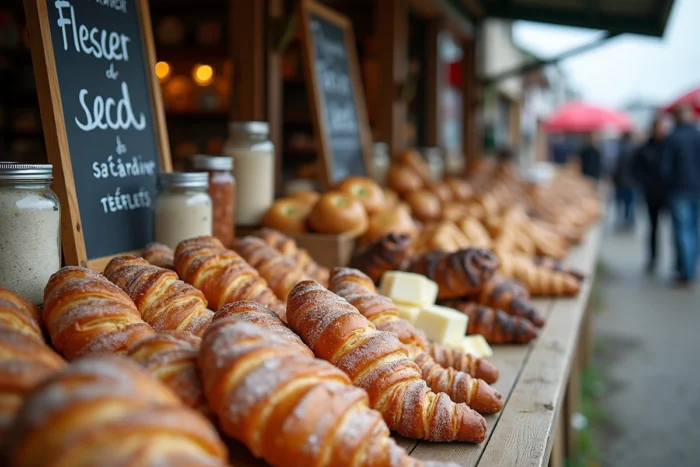
Buckwheat, salted butter, and seaweed: the raw materials that define Breton terroir
Breton specialties rely on a limited number of basic ingredients, but their quality determines everything else. Buckwheat remains the emblematic grain of Breton galettes. Its cultivation, suited to the region’s acidic soils, had long declined before experiencing a resurgence driven by demand for gluten-free products and the desire to localize supplies.
Salted butter distinguishes Breton pastries from all other regional French traditions. Kouign-amann, sablés, salted butter caramel: this semi-salted or salted fat gives Breton products their signature taste. The artisanal dairies that still churn their butter on the farm are few in number, but their production directly supplies local bakeries.
Seaweed constitutes the third pillar, less known but expanding. From seaweed pâtés to seaweed tartars, the sector is organizing around coastal harvesters who work on the foreshore. Available data does not allow for a conclusion on the exact share of seaweed in Breton artisanal turnover, but their presence in product ranges has significantly widened in recent years.
Artisanal seafood products
The Breton artisanal cannery is not limited to sardines. Mackerel rillettes, fish soup, tuna in olive oil: these products perpetuate a know-how that dates back to the first industrial canneries in Morbihan and Finistère. However, the distinction between “artisanal” and “semi-industrial” remains blurry for the consumer, as no official label specifically protects the term “artisanal” applied to canned fish.
- Vintage sardines, aged for several years in a can, represent a niche segment where a few Breton canneries stand out with traditional recipes and manual packaging.
- Fish rillettes often combine several local species (pollock, scallops, lobster) with seasonings from the Breton terroir such as Espelette pepper or seaweed.
- Seaweed pâté, blending Breton pork and seaweed harvested from the coasts, embodies the meeting of land and sea characteristic of the region’s gastronomy.
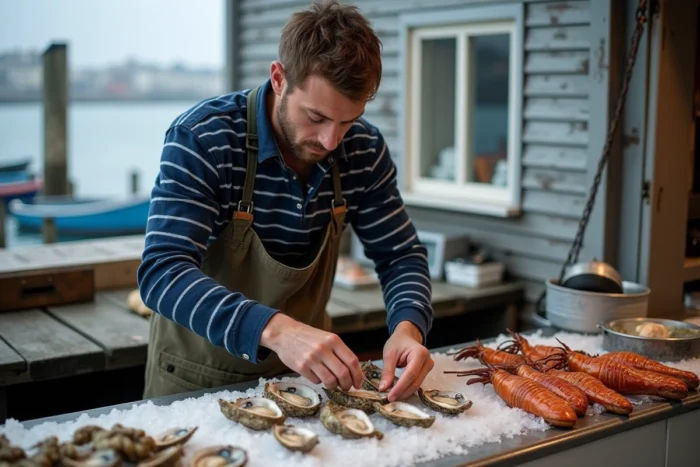
Sustainable gastronomy in Brittany: less sugar, more traceability
A fundamental trend runs through Breton artisanal production: the reduction of sugar and the emphasis on fruit content in recipes. Producers like La Ferme du Pigny explicitly communicate in 2026 about “fruit-rich, sugar-poor” jams, presented as a concrete variation of sustainable gastronomy.
This movement responds to dual pressure. On one side, consumers seek products perceived as healthier. On the other, artisans find it a differentiation argument against large retailers, which offer “terroir” ranges at cut prices but with often longer ingredient lists.
Traceability becomes both a commercial argument and a regulatory obligation. At markets in Morbihan or in producers’ shops, labels increasingly mention the precise origin of raw materials: the municipality where the buckwheat was harvested, the name of the dairy farm, the fishing area of the sardines.
Local markets and short circuits in Morbihan
Markets remain the preferred sales channel for many Breton artisans. They allow for direct contact with the customer and a margin higher than that of store distribution. Morbihan concentrates a particularly dense offer of artisanal products, from farm charcuterie to ciders from small producers.
- Artisanal dry sausage from Brittany, often seasoned with buckwheat or cider, comes in smoked or natural versions depending on the workshops.
- Chouchen (Breton mead) and farm cider complete the ranges of producers present at the markets, with fermentation methods varying from one estate to another.
- Artisanal bakeries offer sablés, palets, and galettes in small batches, often packaged in reusable metal boxes that also serve as souvenir gifts.
Artisanal Breton specialties: what “handmade” really means
The term “artisanal” does not benefit from uniform legal protection across sectors. In bakery-pastry, the mention “artisan” is regulated by law. For canneries, charcuteries, or confectioneries, the boundary between artisanal production and small industry mainly depends on the size of the workshop and the degree of automation.
A kouign-amann workshop that shapes each cake by hand and another that uses a semi-automatic puff pastry line can both claim to be “artisans.” The consumer seeking authentic Breton flavors should therefore check a few concrete indicators: the ingredient list (preferably short), the mention of the origin of raw materials, and the presence of the producer themselves at the point of sale.
Breton artisanal specialties derive their value from this tension between claimed tradition and adaptation to contemporary standards. The regulatory framework is strengthening, consumer expectations are evolving, but the essence remains the same: buckwheat, salted butter, seafood products, and artisans who transform these materials on a small scale.