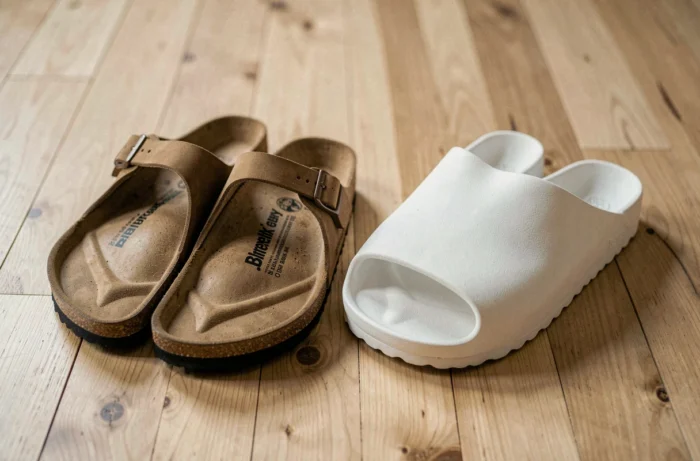
Comparing Billowy and Birkenstock comes down to measuring two sole philosophies based on specific criteria: arch support, performance after several hours of walking, resistance in humid environments, and material durability. The two brands occupy very different price segments, but the price gap does not fully reflect the actual benefits for the foot.
Anatomical sole and foot support: test data
| Criterion | Billowy | Birkenstock cork | Birkenstock EVA |
|---|---|---|---|
| Arch support | Low | High | Moderate |
| Comfort after 6 hours of walking | Insufficient | Good | Fair |
| Saltwater rinsing | Not guaranteed | Not recommended | Easy |
| Main target | Children | Adults | Adults / beach use |
This table highlights a structural gap. The low arch support of Billowy limits its suitability for prolonged wear, while the cork sole of Birkenstock maintains a comfort level rated as “good” beyond six hours of walking.
A detailed Billowy vs Birkenstock comparison confirms that the difference becomes more pronounced during prolonged use, where soft soles lose their cushioning ability.
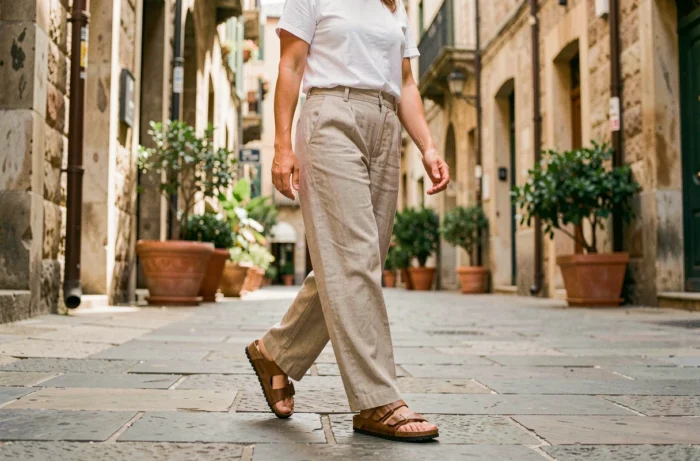
Prolonged use and humid environments: where the foot tires
Foot fatigue does not manifest in the first ten minutes. It appears after several hours, when the sole stops absorbing shocks and the foot seeks support that it can no longer find.
Billowy, with its soft construction aimed at children, offers appreciable freedom of movement for short periods. However, beyond six hours, Billowy’s comfort is deemed insufficient according to available tests. The foot slips, the arch is no longer supported, and the gait deteriorates.
The specific case of the beach and pool
Saltwater is a wear factor often overlooked in comparisons. Birkenstock cork does not withstand rinsing in saltwater, which prohibits direct use on wet sand. Birkenstock’s EVA range solves this issue with a washable synthetic material while maintaining moderate arch support.
Billowy does not guarantee the same versatility in humid environments. For regular use by the seaside, the EVA model from Birkenstock remains the most suitable among the three options compared.
Podiatric criteria: what foot professionals recommend
The French Union for Foot Health (UFSP) sets clear criteria for healthy footwear. Fabien Beuzon, podiatrist and member of the UFSP, reminds us that Birkenstock “can be interesting” if well tolerated, as it stands out from very flat open shoes by providing more comfort.
The UFSP’s recommendations for foot-friendly shoes include several specific points:
- A minimum of support and cushioning, with a sole thick enough to absorb impacts on the ground
- A suitable sole width, preferably wide, to avoid lateral compression of the foot
- A moderate heel, around 3 cm, and a non-slip surface to limit slips
On these criteria, Birkenstock cork ticks most boxes except for the moderate heel, as its models remain very flat. Billowy, on the other hand, does not meet the support and cushioning requirements for daily wear in adults.
Blandine Van Gysel, also a podiatrist at the UFSP, nuances by stating that the support under the arch provided by Birkenstock “is not physiological,” but it can relieve tired feet from the continuous wear of very flat open shoes.
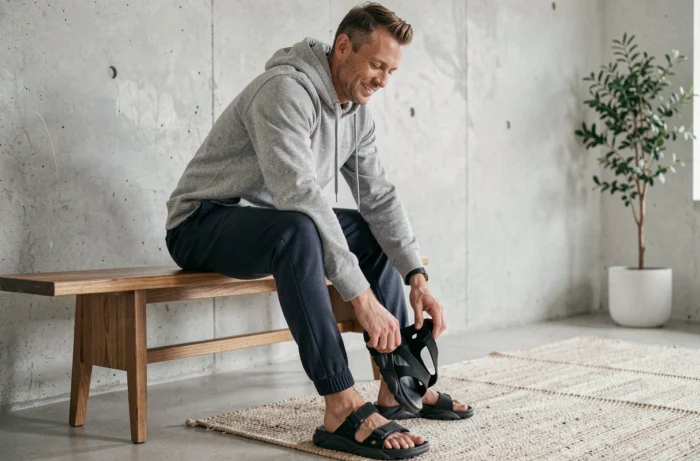
Birkenstock cork or EVA: two soles, two distinct uses
Grouping all Birkenstock models under one label skews the comparison. Cork and EVA are not intended for the same use.
- Cork offers high arch support and gradually molds to the foot, but it is sensitive to moisture and requires regular maintenance
- EVA provides moderate support with the advantage of being washable, lightweight, and resistant to saltwater, making it a relevant choice for the beach or pool
- The price of EVA is significantly lower than that of cork, which reduces the gap with Billowy in the entry-level segment
The choice between these two variants directly depends on the context of use. For a day of walking in the city, cork wins. For mixed use including humid environments, EVA is a more coherent compromise.
Billowy for children, Birkenstock for adults: a positioning that guides the choice
Billowy designs its models for growing feet, with soft materials and colorful designs suitable for children. This orientation partly explains the limited arch support: a developing child’s foot does not have the same needs as an adult foot subjected to hours of standing.
Birkenstock, on the other hand, primarily targets adults with an anatomical sole designed for prolonged walking. Comparing the two brands on the same adult criteria mechanically favors Birkenstock, as Billowy was not designed for this use.
For a parent looking for affordable children’s sandals for limited wear durations, Billowy fulfills its role. For an adult who wears sandals daily for several hours, the data points to Birkenstock, either cork for the city or EVA for humid environments.
The decisive factor remains the duration of wear. Below a few hours, the comfort difference between the two brands diminishes. It is after six hours that the gap becomes measurable, and it is on this data that the choice should be based.


