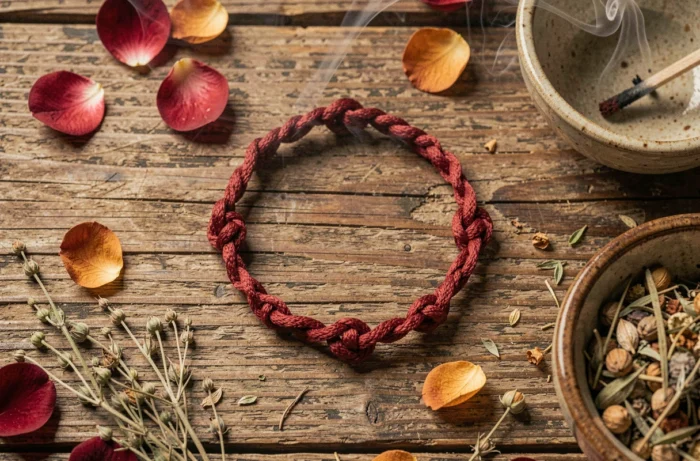
A simple red wool cord tied around the left wrist, with seven tight knots one by one: the red thread bracelet with 7 knots is one of the most widespread protective objects in the world. Its most documented origin dates back to the Jewish Kabbalistic tradition, where the thread is cut after wrapping around Rachel’s tomb, near Bethlehem.
Each knot corresponds to a specific intention, and the tying ritual follows a protocol that is anything but improvised.
Seven knots or nine knots: the variations that Kabbalah does not summarize
Most articles on the subject focus on the Kabbalistic tradition. This makes sense, as it is the most well-known version in the West. However, the red knot bracelet also exists in other ritual contexts, with different rules.
In Taoist feng shui, for example, seven or nine knots on a red thread are frequently used, sometimes with a protective eye-shaped bead placed in the center. The choice between seven and nine knots depends on the intention: personal protection or space harmonization. The thread can be made of cotton, silk, or wool, depending on local tradition.
In Buddhist practices, the knotted red cord is blessed by a monk before being worn. The emphasis is less on the number of knots than on the blessing itself. In Latin America, a red thread on an infant’s wrist protects against “mal de ojo” (evil eye), with no imposed number of knots.
One point to remember: the number seven is not universal; it belongs to Kabbalah and Taoism. Other traditions use the red thread without fixing this number. If you wear this bracelet outside of a specific religious framework, it is the gesture of intention that matters, not the count.
To delve deeper into the meaning of the red thread bracelet with 7 knots, purification and activation are two preliminary steps before wearing the bracelet.

Red thread bracelet tying ritual: what each knot fixes
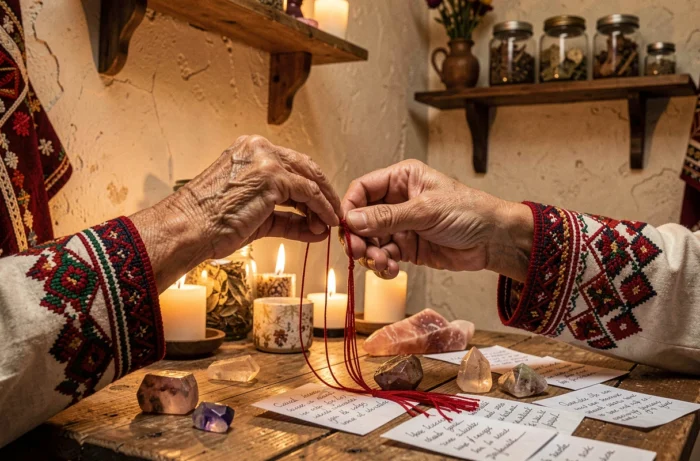
Have you ever seen someone tie a red bracelet on a loved one’s wrist? This gesture is not decorative. In the Kabbalistic tradition, the bracelet must be tied by someone who loves you, not by yourself. The reason is simple: the emotional bond between the one tying and the one wearing reinforces the protective value of the thread.
Each knot is tightened while reciting an intention or prayer. The most common prayer in Kabbalah is the Ben Porat Yosef, recited at each knot. Here’s what the ritual concretely involves:
- The red wool thread is cut to the length of the wrist, with a margin to form the knots without the bracelet being too tight
- The person tying pronounces a distinct intention at each knot (protection, health, love, serenity, luck, clarity, gratitude are common examples)
- The bracelet is placed on the left wrist, considered the receiving side of the body in Kabbalah
- Once the seven knots are tightened, the wearer commits not to remove the bracelet voluntarily
A technical point often overlooked: the quality of the knot matters. A flat knot (the one used for shoelaces) slips and comes undone. A simple knot tightened twice holds better on wool. If the bracelet breaks by itself, tradition holds that it has absorbed what it was meant to protect you from.
Red thread and scientific evidence: what psychology observes
No clinical study demonstrates that a red thread protects against the evil eye. This fact deserves to be stated clearly, as the vast majority of content on the subject remains purely symbolic or spiritual without ever addressing the question of evidence.
What is documented, however, falls under behavioral psychology. Wearing an object charged with intention alters attention and the feeling of control. The bracelet acts as a permanent physical reminder of a personal commitment. Each time the gaze falls on the red thread, the intention set during the tying comes back to consciousness.
This mechanism is comparable to what psychologists call “anchoring”: an object associated with an emotional state eventually triggers that state upon contact. The red thread then functions less as a magical shield than as a mental lightning rod that refocuses attention.
This does not detract from the spiritual dimension for those who experience it. But understanding this dual level (ritual and cognitive) allows one to wear the bracelet knowingly, without expecting from it what it cannot provide.
Red thread bracelet: wool, cotton, or silk, the material changes the ritual
Why red wool rather than another textile? In Kabbalah, wool is the prescribed material. Rachel’s tomb is surrounded by a wool thread, and the bracelets are cut from this thread. The color red refers to protection and vitality in many cultures, but it is specifically wool that carries the symbolic charge in this tradition.
In Taoist practice, the thread can be made of braided red silk, often finer. In Latin America, a simple cotton cord is sufficient. The material is not interchangeable from one tradition to another:
- Wool absorbs moisture and deforms, making purification with saltwater inadvisable (it weakens the fibers and alters the knots)
- Silk holds knots tighter but does not come from the same ritual lineage as Kabbalistic wool
- Cotton is neutral and accessible, suitable for a personal approach without a specific religious anchor
If you buy a red thread bracelet from a jeweler or online, check the composition of the thread before applying a purification protocol. Fumigation with white sage is suitable for all textiles. Immersion in saltwater, however, should be reserved for stones and metals.
The red thread bracelet with 7 knots transcends time and continents with one constant: it materializes an intention set at a specific moment, through a shared gesture. Whether seen as a spiritual symbol of protection against the evil eye or a concrete psychological anchor, the tying ritual remains the heart of the practice. The thread breaks, is replaced, is retied. It is the gesture that persists.


