
Piveteau Bois is one of the few French manufacturers that controls the entire supply chain, from the sawmill to granulation. Its HP+ pellets, produced in Vendée and Corrèze from French softwoods, hold a special place in the wood heating market. Their reputation is based on demanding certifications and a specific manufacturing process, but the price and field feedback deserve careful examination.
Low-temperature drying and I-COMBUST technology: what sets Piveteau’s manufacturing apart
Most wood pellet manufacturers dry their raw material at high temperatures to speed up production. Piveteau uses a low-temperature drying process that preserves the natural resin of softwoods (pine, douglas fir, spruce). This resin acts as a binder during compression, allowing for the omission of additives, glues, or solvents.
The brand also highlights its I-COMBUST technology, which is said to optimize pellet consistency. On paper, this translates to a reduced fine content and more uniform combustion. Field feedback varies on this point: some users indeed notice less residue in the burner, while others do not perceive a significant difference compared to competing pellets certified DINplus.
Piveteau was the first French sawmill certified DINplus for its pellets (label no. 7A109). The HP+ also carries the ENplus certification (FR 037). Both labels require regular checks on calorific value, moisture content, ash content, and mechanical durability. Collecting reviews on Piveteau pellets allows for cross-referencing these normative data with the real-life experiences of users on a daily basis.
Piveteau pellet prices in 2026: where do they stand in the market
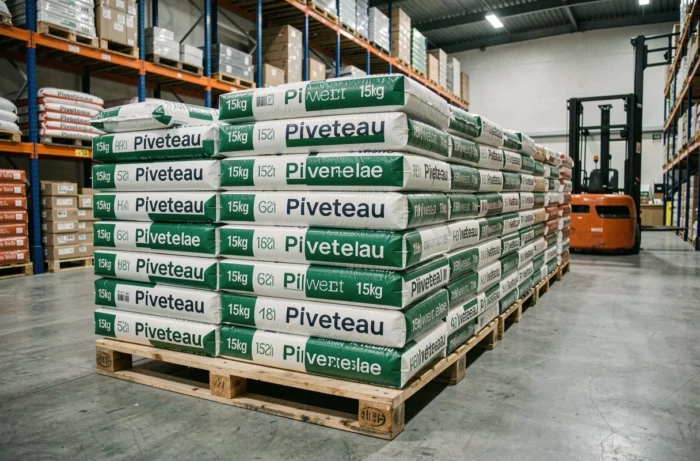
The pricing positioning of the HP+ has long been perceived as above average. Recent data nuance this image. In 2026, a pallet of certified pellets is traded between 360 and 430 euros depending on the brands, region, and distribution channel. Piveteau’s HP+ falls within this range, without deviating significantly.
This price convergence is explained by the overall evolution of the market. After the spike of 2022-2023, prices returned to more moderate levels in 2024, with a 15 kg bag averaging around 7 euros nationally. Since then, an upward trend has re-emerged, driven by European demand and logistics costs.
What the price doesn’t reveal about the real cost
Comparing two pallets at face value is not enough. A pellet that produces less ash reduces the frequency of cleaning the stove or boiler. A lower moisture content improves energy efficiency per kilogram burned. Over a full season, these parameters can offset a difference of a few dozen euros at purchase.
- The ash content of the HP+ is reported to comply with DINplus requirements (below 0.7%), which limits the fouling of the burner and ducts.
- The moisture content, kept below 10%, contributes to a high calorific value relative to the bag’s weight.
- The high mechanical durability reduces the proportion of dust in the bag, a factor that directly affects the operation of the augers in pellet stoves.
User experiences with Piveteau pellets: what users say
Specialized forums and community platforms allow for a significant volume of feedback to be gathered. Several recurring observations emerge.
The consistency from one batch to another is the most frequently praised point. Users who have tested several brands over the seasons note that the HP+ maintain stable performance in their stove, without needing to adjust the air flow between bags. This is not trivial: an irregular pellet forces recalibration of the stove, which degrades efficiency and increases emissions.
However, some feedback points to a value-for-money ratio that is no longer as clear-cut as before. The general upgrading of French and European manufacturers has narrowed the qualitative gap with lesser-known brands that are also certified DINplus or ENplus.
Limitations identified by users
The packaging in 15 kg or 10 kg bags is suitable for domestic storage, but the cost per ton remains higher than that of bulk for owners of boilers equipped with a silo. Piveteau does not offer bulk delivery under its HP+ brand, which effectively excludes part of the market.
Another point raised is regional availability. Piveteau has production sites in Vendée and Corrèze, which logistically favors the greater West and central France. In the North or East, delivery times and costs can erode the competitive advantage.
Piveteau pellet and certified alternatives: useful comparison criteria
Rather than creating a ranking, it is more relevant to identify the discriminating criteria at the time of choice.
- The DINplus or ENplus certification remains the primary filter. An uncertified pellet, even cheaper, exposes users to combustion issues and may void the warranty of certain stoves.
- The origin of the wood (softwood vs hardwood vs mix) influences calorific value and ash content. Pure softwoods, like those used by Piveteau, generally offer better calorific efficiency.
- The proximity of the production site reduces the carbon footprint of transport and often the final price.
- User feedback on your specific stove or boiler model is as important as the technical data sheet of the pellet. Some devices perform better with a specific diameter or density.
The French wood pellet market has rapidly structured itself in recent years. The gap between premium pellets and standard certified pellets has narrowed, both in measured performance and price. Piveteau maintains an advantage in the traceability of its raw material and manufacturing consistency, two elements confirmed by available data. For the rest, the choice depends as much on geographical proximity and the type of device as on the name printed on the bag.