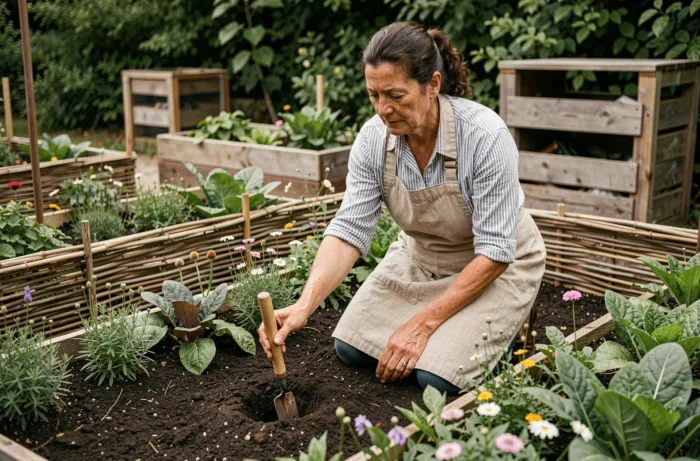
The grelinette remains the reference tool in permaculture, but reducing ecological tools to this single instrument ignores an entire generation of equipment designed to work the soil without turning it, manage water without wasting it, and maintain plots without thermal motorization. We have observed for several seasons a convergence between regulatory constraints, agronomic requirements, and technical innovations that is concretely changing the way to equip a permaculture garden.
Soil working tools without turning: beyond the classic grelinette
The founding principle of permaculture gardening can be summed up in one sentence: decompact without inverting the soil horizons. The five-tooth grelinette fulfills this role, but its design has evolved. Models forged from boron steel offer superior resistance on clay soils, where ordinary steel versions bend after two seasons.
Flat-tined digging forks complement the grelinette on stony ground. Their more open attack angle limits jamming between stones. On permanent cultivation beds less than one meter wide, a simple four-tooth cultivator is sufficient to aerate the top few centimeters before direct seeding.
We recommend consulting the technical sheets available on grelinette-warrior.com to compare tooth geometries according to your soil texture. The choice between curved and straight teeth radically alters the lever effort and depth of decompaction.
- Forged five-tooth grelinette for wide beds (80-120 cm) in loamy or clay-loam soil: the versatile reference
- Flat-tined digging fork for stony plots or heavily compacted soils after construction
- Four-tooth cultivator for superficial maintenance between two crops, without disturbing the established fungal network
- Pedal aerator for gardeners with back constraints, transferring the effort to the legs
Water management in permaculture: micro-irrigation and rainwater harvesting
A well-sized drip system significantly reduces water consumption compared to sprinkler irrigation. In permaculture, where permanent mulching covers the soil, buried drip lines under the mulch further limit evaporation.
Pore-filled hoses made from recycled rubber are an alternative to rigid polyethylene tubes. Their porosity diffuses water along their entire length, making them suitable for mounds and curved beds. However, their flow is less controllable: on even slight slopes, distribution becomes uneven.
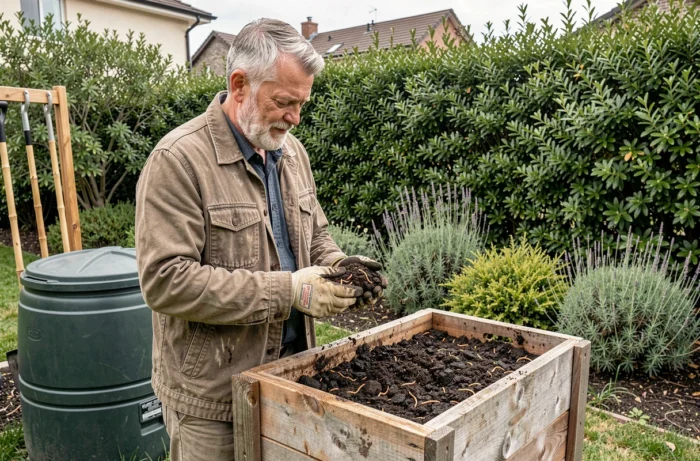
Rainwater harvesting remains the cornerstone of water autonomy. A collector paired with a leaf filter and a first flush valve eliminates sediments and pollutants accumulated on the roof. The first flush valve is the most overlooked yet crucial component for the quality of stored water.
Sizing storage according to cultivated area
The storage capacity depends on local rainfall and the area of the catchment roof. In a Mediterranean climate, an average permaculture garden requires a reserve volume much larger than that of a garden in an oceanic climate to cover the same summer period without external input. Multiplying small-volume tanks rather than investing in a single large tank facilitates installation and distribution of watering points.
Maintenance without thermal motorization: the regulatory framework pushes for alternatives
Since decree n°2023-924 of October 5, 2023, the fixed fine for noise nuisance related to gardening tools can reach 135 euros, and up to 750 euros in case of repeat offenses. This tightening adds to the already restricted time slots set by municipal orders.
Since June 2025, about twenty departments in the South and Southwest (Var, Gard, Hérault, Gironde, among others) prohibit mowing between 12 PM and 4 PM during heatwave alerts. These restrictions accelerate the adoption of silent manual or electric tools.
Concrete alternatives to thermal tools
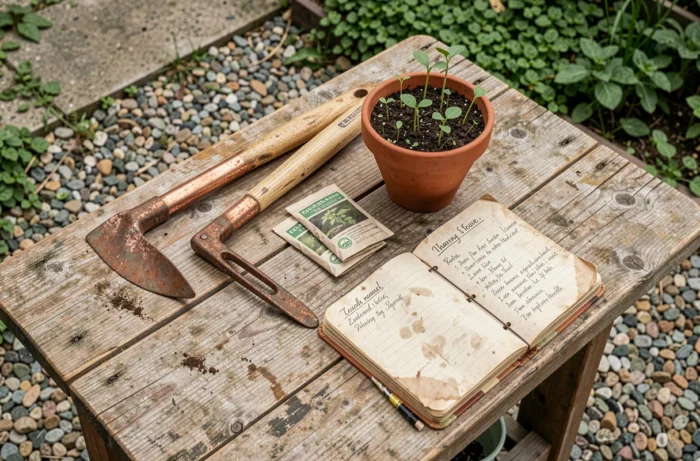
The manual reel mower is suitable for small lawn areas that many permaculturists maintain in zones 2 or 3 of the design. Its noise level, lower than that of a conversation, allows it to be used without time restrictions.
For weeding pathways, the oscillating hoe (or pendulum weeder) cuts weeds below the surface without bringing buried seeds to the surface. This is a more relevant choice than the flame weeder, which sterilizes the top layer of soil and destroys microbial life.
- Manual reel mower for residual grass areas, without noise or fuel
- Pendulum weeder for pathways and spaces between mounds, effective on young weeds
- Ratchet pruner for pruning small fruit trees, reducing hand cutting effort
Biodiversity and direct seeding tools in permaculture
Direct seeding in the field, without prior tillage, requires suitable tools. Manual seeders with rollers allow for regular seed spacing in a furrow marked with a string. Precision seeding limits seed waste and reduces thinning, two critical points in organic gardening.
For companion planting (vegetables, herbs, flowering plants), the bulb planter is also used to install companion plant pots among the beds. Permaculture relies on plant diversity, and the ease of planting conditions the actual richness of the system. A garden designed on paper with fifteen associated species but planted with a simple pointed stick often ends up with five species due to fatigue.
Investing in quality manual tools, forged and repairable, remains the most structuring decision for a permaculture garden. A well-designed tool lasts several decades, consumes no fossil energy, and generates no nuisance. In the face of the gradual tightening of noise regulations and watering restrictions, ecological tools are no longer a militant choice but a technical response to the constraints of the land and the legal framework.


