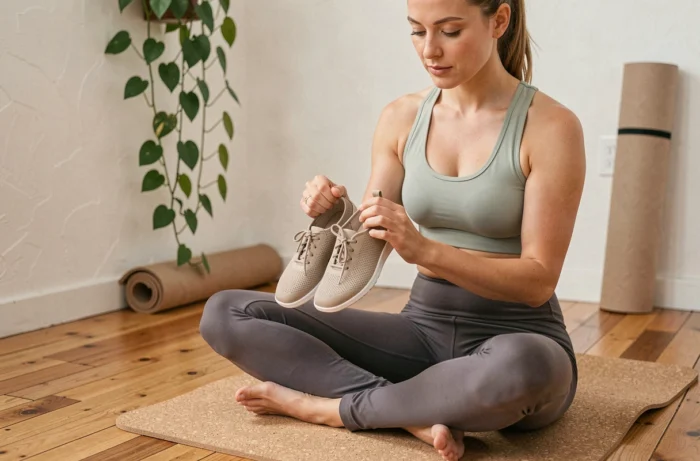
Yoga is mostly practiced barefoot. This convention, rooted in tradition, enhances proprioception and direct contact with the ground. However, several situations challenge this reflex: practicing outdoors on cold or uneven terrain, orthopedic issues, excessive sweating that compromises grip on the mat. In these specific cases, an appropriate shoe becomes a relevant choice, provided that one does not confuse yoga shoes with regular sports shoes.
Thin sole and flexibility: what foot biomechanics require in yoga
The uniqueness of yoga compared to other disciplines lies in the variety of supports. A Vinyasa sequence successively mobilizes the sole of the foot, the heel, the spread toes, and the top of the foot during certain floor postures. A rigid shoe or one with thick cushioning blocks these micro-adjustments.
Minimalist models, with an ultra-thin sole and zero drop, closely replicate the sensation of being barefoot. Their wide toe box allows the toes to spread naturally, which contributes to stability in balance postures like Vrksasana (the tree).
A meta-analysis published in 2024 in Clinical Biomechanics (Peters-Dickie et al.) confirms that regular use of minimalist shoes increases the strength of the intrinsic muscles of the foot. The level of evidence remains low to very low for injury prevention.
The muscular benefit is documented, but not the protection against trauma. For a practitioner looking to gradually strengthen her foot, the minimalist model presents a real interest. For someone already suffering from a plantar pathology, caution is advised.
Choosing among yoga shoes for women suitable for her morphology and practice requires checking several technical criteria before any purchase.
Transition to minimalist shoes in yoga: a pace to respect
One of the least addressed angles in buying guides concerns the adaptation period. Wearing a minimalist shoe is not improvised, even in a discipline as gentle as yoga.
Controlled trials on runners have shown that a too-rapid transition to minimalist shoes (over about ten weeks) can cause signs of bone injury, including bone marrow edema and, in some cases, stress fractures. In contrast, a transition spread over six months, combined with calf strengthening, did not result in injury.
Yoga engages the foot differently than running, with less impact. Feedback varies on this point: some practitioners report initial discomfort during prolonged standing postures, while others adapt within a few sessions. The logic remains the same as for any barefoot or nearly barefoot activity: start with short sessions and gradually increase the duration.
Warning signs to watch for
- Pain under the heel or in the arch of the foot after the session, which persists beyond a few hours. This is often a sign of overloading the plantar fascia.
- Unusual sensitivity on the top of the foot or at the metatarsals, which may indicate early bone stress.
- Excessive muscle fatigue in the calves, signaling that the stabilizing muscles are not yet ready for this prolonged demand.
Grip and materials: concrete criteria for yoga indoors and outdoors
Grip is the most discriminating criterion. Indoors, on a regular mat, the sole must provide sufficient grip without sticking to the point of hindering transitions between postures. Natural rubber soles with non-slip patterns generally fulfill this function.
Outdoors (grass, terrace, compacted sand), the requirements change. The sole must protect against roughness while remaining thin enough to maintain sensory feedback. A difficult compromise: the more the sole protects, the less it transmits information from the ground.
Breathability and maintenance
A yoga shoe worn directly on the skin quickly accumulates moisture and bacteria. Mesh synthetic materials offer good ventilation but wear out faster. Models made from organic textiles (cotton, linen) breathe well as long as they are washed regularly.
A often overlooked point: the yoga shoe should be machine washable or easily hand washable. Models with removable insoles facilitate drying and limit odors.
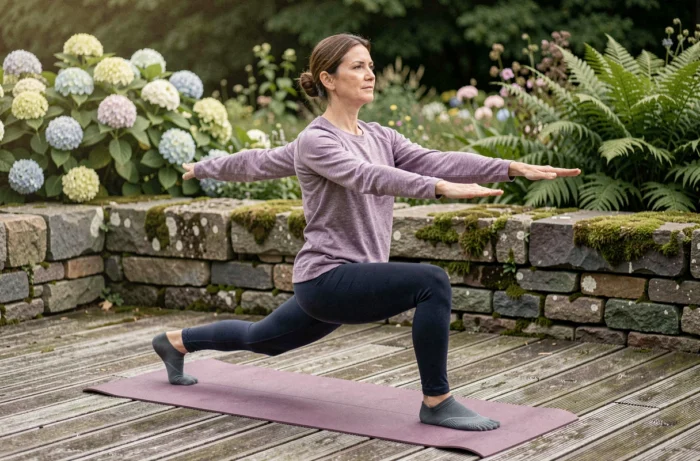
Yoga shoe, non-slip sock, or barefoot: when to choose what
The choice is not limited to shoe or no shoe. The non-slip sock constitutes a third option, often more suitable for indoor practice for those simply seeking better hygiene or additional grip without altering the sensation of being barefoot.
- Barefoot: the reference for yoga indoors on a clean mat, at home or in a studio. Maximum proprioception, no obstacles to foot movements.
- Non-slip sock: suitable for shared studios (hygiene), for feet that sweat a lot, or for practitioners who find direct contact with the mat uncomfortable. Does not alter foot biomechanics.
- Minimalist shoe: justified for outdoor yoga, sessions on cold ground, or for practitioners with identified orthopedic needs. Provides protection and warmth but partially reduces sensory feedback.
- Regular sports shoe: unsuitable for yoga. Cushioning and rigidity prevent toe splaying and distort supports in balance postures.
The right reflex is to first identify the practice context before focusing on a model or brand. A practitioner who alternates between studio sessions and sessions in her garden may need two different solutions rather than a single compromise that does not satisfy either situation.
The market for minimalist shoes for yoga remains an expanding niche. The available scientific data supports the interest in muscle strengthening related to wearing thin soles, without guaranteeing increased protection against injuries. The most relevant choice depends less on trends than on an honest diagnosis of one’s own needs: type of ground, frequency of practice, foot health status.


