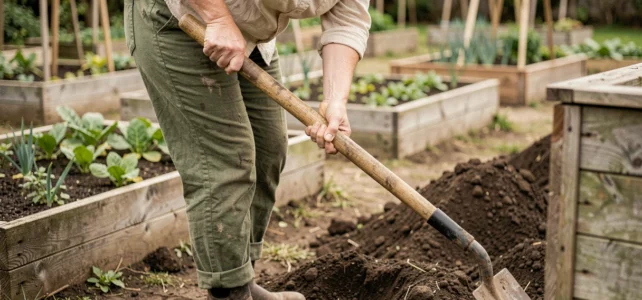
The grelinette is a tool with tines that allows you to loosen the soil without turning it over. Unlike a traditional spade, it lifts and cracks the ground while preserving the natural arrangement of the layers. For an ecological vegetable garden, this difference changes everything: microbial life remains in place, water infiltrates better, and the gardener tires less.
What the grelinette does to the soil at depth
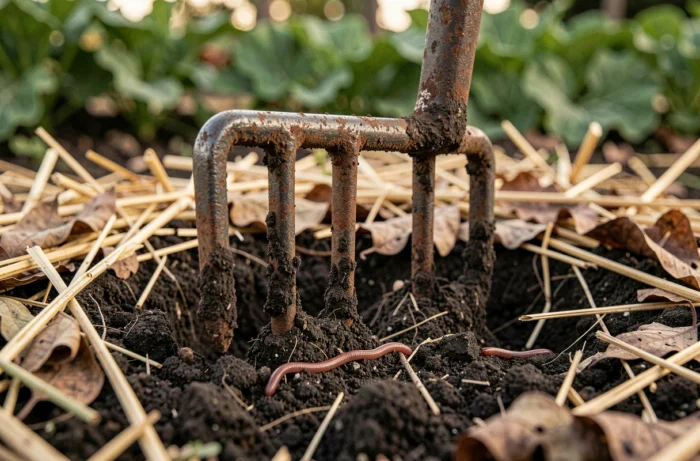
Have you ever noticed, when turning over a scoop of soil, earthworms cut in half and a smell of damp earth rising? This brutal mixing disturbs the soil horizons. Aerobic microorganisms, which live on the surface, get buried. Those that work deep down, in an oxygen-free environment, die when exposed to air.
The grelinette avoids this upheaval. Its tines penetrate vertically, and then a backward rocking motion cracks the soil without inverting the layers. Mycorrhizal fungi and bacteria remain at their level. This fungal network, which transports water and nutrients to the roots, takes several months to rebuild after traditional digging. With the grelinette, it remains intact.
The structure of the soil also improves mechanically. The cracks created by the tines form channels where rainwater can descend instead of running off the surface. On compacted clay soil, this makes the difference between a soil that becomes waterlogged and one that breathes. To delve deeper into the technical characteristics of the different models, the detailed sheets on grelinette-warrior.com allow for comparisons of the number of tines, working width, and materials.
Grelinette and regulations: a tool suitable for chemical-free gardening
Since the extension of the Labbé law, amateur gardeners can no longer buy or use synthetic chemical herbicides, including those based on glyphosate. Mechanical weeding is no longer a militant choice: it is the rule.
The grelinette fits directly into this framework. By loosening the soil, it uproots weeds without resorting to a product. Mechanical weeding replaces chemical methods, and the grelinette is the suitable tool.
Another deadline to be aware of: under the Climate and Resilience law, synthetic mineral fertilizers will be banned for non-agricultural uses by January 1, 2027. In practical terms, to maintain the fertility of a vegetable garden, one will need to rely on compost, manure, or green fertilizers. The grelinette facilitates the superficial incorporation of these organic amendments, without burying the compost too deeply where it would not decompose properly.
The European Union is also preparing a directive on soil monitoring, with a public data portal on soil health expected by December 2027. No-till farming is among the indicators of good practices. Gardening with a grelinette is already aligning with these future frameworks.
Technique for use on different types of soil
The most common mistake is to push the tines all the way into dry, compact soil and then force on the handles. The result: twisted tines or guaranteed back pain.
Here are the steps for an effective pass:
- Work when the soil is slightly moist, neither waterlogged nor dry. After moderate rain or watering the day before, the soil cracks without sticking to the tines.
- Plant the tines using the weight of your foot, not your arms. Place one foot on the crossbar and let your body weight do the work of pushing down.
- Rock both handles towards you in a steady motion. The lever effect lifts the soil. Do not try to turn it over: the clod should crack in place.
- Step back and repeat. Each pass slightly overlaps the previous one to leave no compacted strip.
On clay soil, make two crossed passes (one in each direction) to break up the toughest clods. On sandy soil, a single pass is sufficient: the soil loosens easily, and excessive work would make it too loose.
When to use the grelinette in the vegetable garden
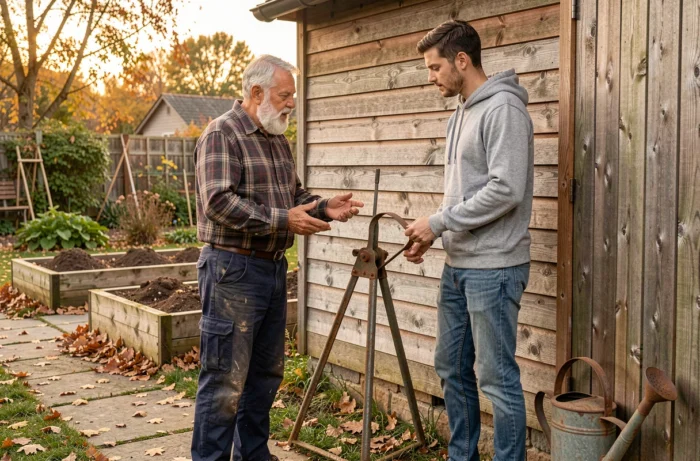
Two periods are particularly well-suited for using the grelinette: autumn, after the last harvests, and early spring, before sowing.
In autumn, the soil is still warm and the rains naturally moisten it. It is the time to incorporate compost on the surface, then use the grelinette to integrate it into the top few centimeters. Winter frost will finish breaking up the clods, especially in clay soil.
In spring, a light pass prepares the seedbed. The loosened soil allows vegetable seeds to come into direct contact with aerated soil. Roots develop faster in loosened soil than in a crust formed by winter rains.
In the peak season, the grelinette is also used to loosen the paths of the vegetable garden that have been compacted during harvests. This localized work, between the crop beds, prevents compaction from spreading to the cultivated areas by capillarity.
Choosing your grelinette according to your soil and surface
The number of tines determines the working width, and thus the area covered in one pass. But wider does not always mean better.
- Three to four tines: suitable for small vegetable gardens, heavy soils, or lightweight gardeners. The effort remains moderate, and maneuverability is excellent in narrow spaces.
- Five tines: the most common compromise. Suitable for the majority of gardens and soil types.
- Seven tines or more: reserved for large areas and light soils. On clay soil, penetration requires considerable effort.
The quality of the forged steel tines determines the tool’s lifespan. Hardened steel tines resist bending in rocky soils. Hardwood handles (ash, beech) absorb vibrations better than metal or plastic.
A final often-overlooked criterion: the height of the handles. Handles that are too short force you to bend over, which negates the ergonomic advantage of the grelinette. Standing, with arms extended downwards, your hands should reach the top of the handles without bending your back.
The grelinette does not replace all garden tools. It does not hoe, weed, or dig planting holes. Its role is specific: to loosen and aerate without destroying soil life. It is this specialization that makes it such an effective tool, provided it is used at the right time, on prepared soil, with the right model.