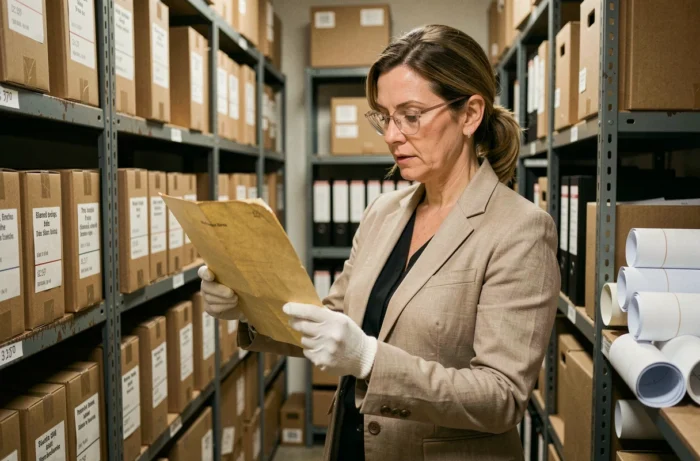
A tax audit is coming, and the accountant is looking for a supplier invoice issued six years earlier. The PDF file exists somewhere on a server, but no one can guarantee that it hasn’t been modified since. The result: the document is dismissed, and the adjustment goes through. This common scenario illustrates why the management of professional archives is no longer limited to stacking boxes or digital files.
Probative Value of Archives: What Matters Beyond Retention Periods
We often talk about legal durations, but rarely about what makes a document truly usable before a judge or an auditor. The retention of archives is pointless if we cannot demonstrate three things: the integrity of the document, its traceability, and the absence of alteration since its issuance.
Let’s take electronic invoices. An invoice used as an accounting document must be retained in its original electronic form. A flattened PDF export, without metadata or certified timestamp, loses its probative value. Retention is not enough; it must be proven that the document has remained intact.
In practice, we distinguish between two levels of archiving. Simple storage (a hard drive, a shared folder) ensures accessibility. Probative archiving, on the other hand, relies on technical mechanisms such as cryptographic sealing, qualified timestamping, and tamper-proof access logs. The first reassures, while the second protects. Specialized providers like les Archivistes assist organizations with this distinction, which remains unclear for many leaders.

Legal Retention Periods and GDPR in 2026: Managing Overlap Without Over-Retaining
The on-the-ground difficulty is that retention periods are not uniform. Tax documents, commercial contracts, pay slips, and HR data each follow different durations set by the Commercial Code, Civil Code, or Labor Code. And these durations change.
In 2026, the retention of tax documents will extend to ten years for electronic invoices on approved platforms. Archives related to professional training follow their own timelines. Employment contracts have a different retention period than pay slips. We end up with a regulatory mille-feuille where each document category has its own schedule.
The symmetrical trap also exists: over-retaining personal data beyond legal necessity exposes one to GDPR non-compliance. Keeping personnel files “just in case” for twenty years is precisely what the regulation prohibits. The destruction of archives becomes an act of compliance, not just administrative housekeeping.
Building an Operational Retention Framework
On the ground, it is recommended to build a document management table that crosses three columns:
- The document category (fiscal, social, commercial, HR, training) and the legal basis that sets its retention period
- The triggering date of the period, which is not always the date of the document (for a contract, it is often the end of the business relationship)
- The final fate planned: secure destruction, transfer to permanent archive, or anonymization for personal data
This framework is only valuable if it is updated when regulations evolve. A table that has been static for three years creates a false sense of security.
Digital Archives and Cybersecurity: A Common Blind Spot
Electronic archiving is often treated as a purely documentary subject. This is a mistake. A poorly protected archiving system is a prime target during a cyberattack.
A note from the Irish Data Protection Commission, published in July 2026, emphasizes the cyber resilience of digital preservation programs. The reasoning is simple: if ransomware encrypts your archives, you lose both your operational memory and your legal evidence. Recovery after an incident becomes impossible if archive backups are not isolated from the main network.
Feedback varies on this point, but several practices are widely agreed upon:
- Physically or logically separate probative archives from the current information system
- Apply the same backup and restoration testing policies to archives as to production data
- Log all access to digital archives to detect a compromise before it becomes irreversible
- Periodically verify the integrity of archived files by comparing cryptographic hashes
Hybrid Archiving: Balancing Between Paper and Dematerialization
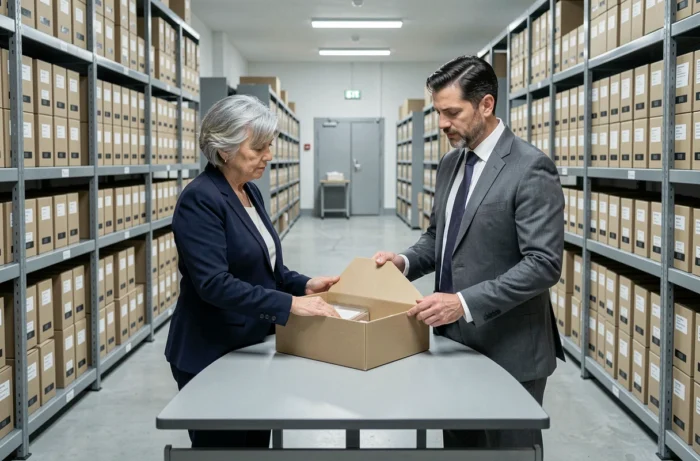
Many companies still operate with a paper-digital mix, and this is not necessarily a problem. All-digital is only relevant if the infrastructure guarantees probative value. Digitizing a hand-signed contract without a certified faithful copy process creates a duplicate without legal force.
Dematerialization brings real gains: instant search, space savings, remote access. For SMEs transitioning to digital, storage must comply with specific standards. A simple public cloud drive does not constitute compliant archiving.
Paper remains relevant for certain originals (notarial acts, documents signed under private seal prior to dematerialization). The right approach is to identify which documents can migrate to electronic form with full legal value, and which must remain in physical format under suitable preservation conditions (temperature, humidity, fire protection).
The management of professional archives in 2026 is played out on three simultaneous fronts: proof, compliance with legal deadlines crossed with GDPR, and protection against cyber incidents. Addressing only one of these fronts without the other two is like locking the front door while leaving the windows open.


