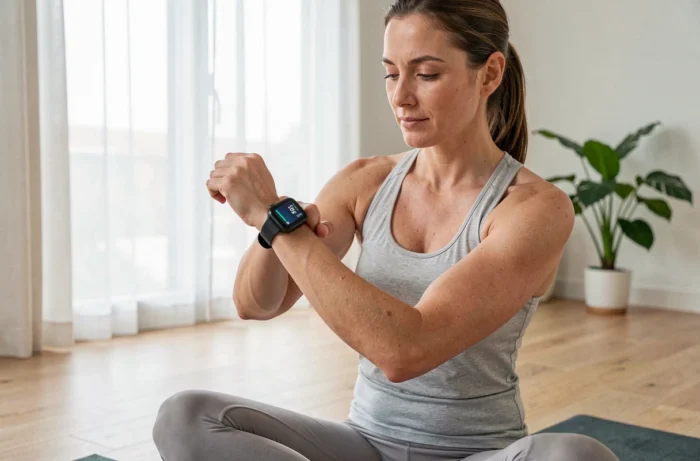
Daily health relies on a set of preventive actions and monitoring tools that allow for early detection, quick action, and the maintenance of a stable physiological balance. Taking care of one’s health is no longer limited to consulting a doctor when symptoms arise: digital solutions and preventive devices are profoundly changing how individuals can monitor their overall condition and adapt their lifestyle habits.
My Health Space: the digital health record as a preventive tool
The public digital health record My Health Space represents a concrete change in individual medical monitoring. This service allows for the centralization of prescriptions, test results, hospitalization reports, and medical correspondence in a secure online space.
By 2025, the platform already had 24 million activated profiles and over 420 million documents uploaded by healthcare professionals, marking an increase of about 40% compared to 2024. This rapid adoption shows that preventive monitoring now relies on digital tools shared between patients and caregivers.
The main benefit lies in the continuity of care. A doctor consulted in an emergency or a specialist seen for the first time can access the medical history without the patient needing to carry their paper documents. For those who wish to learn more about Wype, this logic of centralizing health information aligns with a broader trend towards services that simplify access to care and prevention.
An activated profile is not enough: the tool becomes truly useful when the patient regularly checks that their documents are up to date and allows sharing with their primary healthcare professionals.
Telemedicine and decentralized health: consulting without traveling
Telemedical consultation has moved beyond the experimental stage. Several platforms allow for video consultations with general practitioners, including in the evening and on weekends. This mode of consultation addresses a specific constraint: access to care in areas where medical practices are saturated or nonexistent.
The France 2030 plan structures this offering by funding decentralized care locations. A call for expressions of interest titled “Innovative Offer in Decentralized Health and Telemedicine” supports the installation of teleconsultation booths in train stations, town halls, and public spaces. The goal is to physically bring medical devices closer to those who need them daily.
What telemedicine actually covers
A teleconsultation allows for obtaining a diagnosis for common conditions (infections, prescription renewals, simple dermatology) and receiving a digital prescription. It does not replace a complete clinical examination or follow-up for complex chronic diseases.
Telemedicine works best as a complement to a primary care physician rather than as a total replacement. The ideal use is for situations where waiting for a traditional appointment would unnecessarily delay care.
Active prevention: habits that reduce the need for care
Digital tools do not exempt one from acting on the fundamentals. Active prevention relies on measurable behaviors whose effects on health are documented.
- Regular physical activity (brisk walking, cycling, swimming) reduces the risks of chronic cardiovascular and metabolic diseases. Thirty minutes a day is sufficient to achieve a measurable benefit, without aiming for athletic performance.
- Stress management through structured techniques (heart coherence, mindfulness meditation) directly impacts sleep quality and mental health, two parameters often overlooked in traditional prevention assessments.
- Targeted nutritional monitoring, which involves increasing the intake of fruits, vegetables, and unsaturated fatty acids while reducing salt and refined sugars, serves as an accessible primary prevention lever for all budgets.
These three pillars (physical activity, stress management, nutrition) are not new in themselves. What changes is the ability to measure and track them over time through applications and connected devices that record data over the weeks.

Health apps and connected devices: distinguishing the useful from the gadget
The market for consumer health applications is saturated. Among activity trackers, sleep tracking apps, and nutritional programs, sorting between reliable tools and marketing gadgets remains the main challenge for users.
A simple criterion allows for differentiation: a useful app produces data that can be used by a healthcare professional. A tracker that measures resting heart rate over several months provides relevant information during a cardiology consultation. An app that assigns a “wellness score” without transparent methodology serves only to reassure or unnecessarily alarm without basis.
Criteria for the reliability of a health app
- Certification or listing in the My Health Space catalog, which imposes criteria for data security and interoperability with the healthcare system
- Transparency regarding the algorithms used and the scientific sources cited in the recommendations
- The ability to export data to a healthcare professional or integrate it into one’s digital medical record
The most relevant connected devices are those that measure objective physiological parameters: blood pressure, blood glucose, oxygen saturation. Their added value lies in the regularity of measurement, not in the precision of a single reading.
Support and personalized care pathways
Digital prevention reaches its limits when it operates in a closed circuit. A monitoring tool only makes sense if it integrates into a coordinated care pathway, with a primary care physician who interprets the data and adapts recommendations.
Mutual insurance companies and health support services now offer personalized prevention assessments that combine declarative data (lifestyle habits, family history) with digital data collected by the patient. This approach allows for targeting relevant screenings rather than multiplying systematic examinations.
Daily health is built on a balance between concrete preventive actions and the reasoned use of available tools. The best investment remains regular follow-up with a healthcare professional who knows your history, complemented by digital solutions chosen for their reliability rather than their marketing promise.


