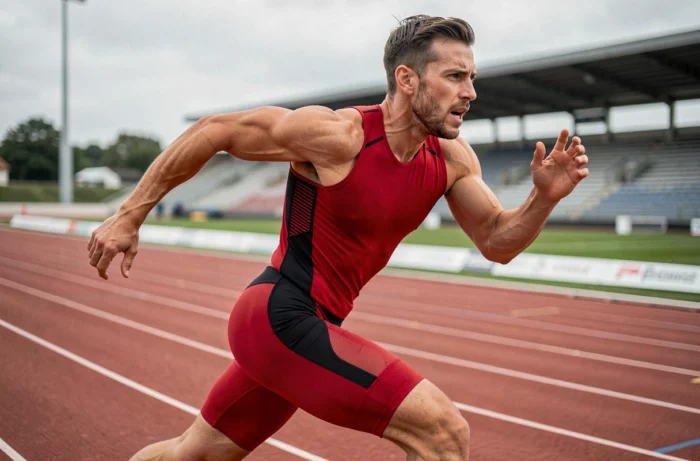
The peak of 44.72 km/h recorded by Usain Bolt in the 100 meters remains, to this day, the highest instantaneous speed ever measured in a human sprinter. This figure fascinates, but it masks a much more technical biomechanical debate about what truly prevents humans from going faster.
Tendon Constraint in Sprinting: The Ceiling Comes from the Ground, Not the Muscles
The common belief is that more powerful muscles produce a faster sprint. Research from the Locomotor Performance Laboratory at Southern Methodist University corrects this interpretation. The speed limit in sprinting is more related to the ability of the tibia and the Achilles tendon complex to withstand forces of over 1,000 pounds per step.
During a maximal sprint, each foot remains on the ground for a fraction of a second. During this support phase, the force transmitted to the ground far exceeds the weight of the sprinter. We observe that fast-twitch muscle fibers (type II) can theoretically generate more force, but the connective structures that transmit this force to the skeleton do not keep pace.
This qualitative constraint refocuses the question on tendon stiffness and connective tissues rather than muscle cross-section. Without targeted adaptations of these tissues, the threshold around 9.50 seconds for the 100 meters is presented as a biomechanical ceiling that is difficult to surpass.
Plyometric training or eccentric work gradually modify tendon compliance, but the margins for improvement remain slim. To delve deeper into the question of the speed limit of the human body, the biomechanics of ground contact is the parameter to monitor as a priority.
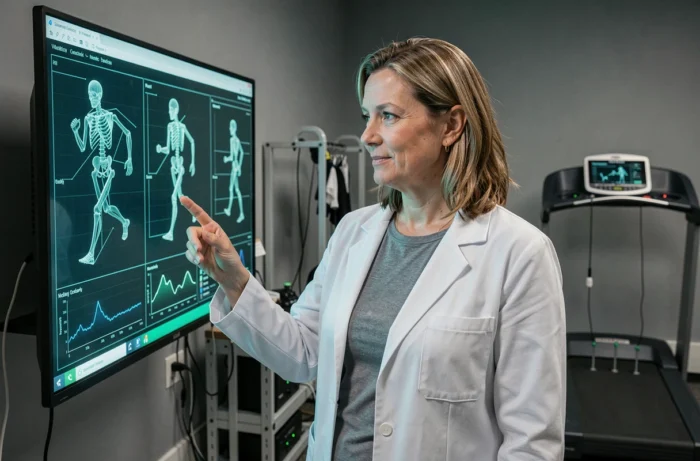
Track and Field Records and Physiological Ceiling: A Close Asymptote
The analysis of thousands of world records since 1896 shows a clear trend: most track and field disciplines are likely to reach their physiological limit in the coming years, while swimming retains more room for improvement.
This divergence between disciplines is explained by the nature of the medium. In running, the body directly experiences ground reaction forces. In swimming, the buoyancy of water and hydrodynamic optimization still offer underutilized technical levers (suits, body positioning, arm frequency).
Why Sprinting Peaks Faster than the Marathon
In sprinting, gains are measured in hundredths of a second and depend on nearly incompressible neuromuscular parameters: reaction time, motor unit recruitment, stride frequency. In the marathon, metabolic optimization (lactate threshold, running economy, nutritional strategy) leaves a broader spectrum for improvement, even though recent records show a clear slowdown in the progression curve.
- The 100-meter record has only been lowered by a few hundredths in nearly two decades, indicating a neuromuscular plateau.
- In the marathon, innovations in carbon-plated shoes have produced a visible performance leap, but this technological effect has its own limit.
- In swimming, analyses show that reducing hydrodynamic drag remains a field where the technical margin exceeds pure physiological margin.

Bipedal Robots and Human Speed: An Unexpected Benchmark
Recent advances in bipedal robotics provide an interesting mirror. The Chinese humanoid robot Tiangong Ultra completed 100 meters in 8.64 seconds, a time lower than Usain Bolt’s world record (9.58 seconds). This performance highlights both the feats and the limitations of human locomotion.
This technical parallel is useful because it isolates pure mechanical constraints (joints, damping, energy transfer) from the biological component (fatigue, thermoregulation, tissue damage). A robot does not have an Achilles tendon that gives way or a lactate threshold that slows down the stride. But it also lacks the real-time adaptability of the human central nervous system, which adjusts muscle stiffness and joint kinematics with each stride.
What Robotics Reveals About Our Own Limits
Comparative biomechanical analysis shows that the energy cost of bipedal running in humans is remarkably optimized compared to current mechanical solutions. The storage and restitution of elastic energy in the Achilles tendon, plantar fascia, and knee ligaments constitute a system of biological springs that no artificial actuator replicates with the same efficiency at equivalent mass.
Thus, human speed records are not merely the result of muscle power or will. They result from an evolutionary compromise between structural resistance, energy efficiency, and tolerance to repeated mechanical stress. This compromise has its own asymptotes, and future gains will be measured in hundredths of a second, not kilometers per hour.


