The white vinegar you use to descale your kettle also cleans your countertop. The Marseille soap that washes your hands also degreases your dishes. These everyday ingredients replace most of the specialized bottles that clutter the cupboard under the sink. Adopting eco-friendly cleaning products is primarily about simplification: fewer references, less packaging, and healthier indoor air.
What the European ESPR regulation changes for eco-friendly cleaners
Competitors rarely talk about regulations, and that’s a shame. The new European regulation on the ecodesign of sustainable products (ESPR) will gradually come into effect starting in 2027. It doesn’t only concern household appliances: household products are directly targeted.
Specifically, this text requires manufacturers to provide a digital product passport. This document must display verifiable information: the proportion of recycled materials, the durability of the packaging, and actual environmental performance. Gone are vague claims like “natural” or “planet-friendly” without proof.
For you, this means it will soon be easier to distinguish a genuine eco-friendly cleaner from a conventional product repainted green. Today, when searching for the best eco-friendly cleaning products, you come across dozens of brands with unclear claims. The digital passport will require each manufacturer to prove what they assert.
The European directive on single-use plastics is already pushing brands towards refillable or deposit packaging. Several manufacturers offer refill pouches for their multi-purpose sprays. The bottle is purchased only once and then refilled. This model reduces the amount of plastic produced and aligns with the circular economy logic that the ESPR will reinforce.
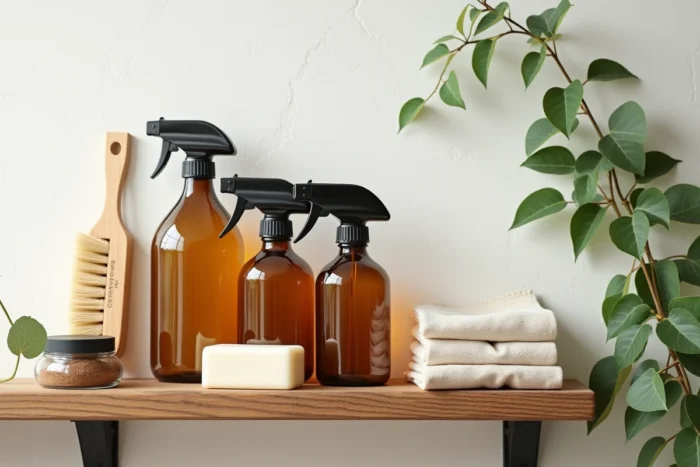
White vinegar, black soap, and baking soda: three basics that cover the entire home
Have you noticed that most commercial sprays are mostly water? The active ingredient represents only a fraction of the bottle. By starting with raw ingredients, you pay for the active product, not the transport of water by truck.
White vinegar against limescale and light grease
White vinegar is a mild acid that dissolves limescale on contact. Faucets, shower walls, kettle bottoms: it works wherever hard water leaves marks. Diluted in warm water, it also cleans windows without leaving streaks.
Do not use it on marble or natural stone. The acidity attacks these porous surfaces and dulls them permanently. For stone floors, prefer black soap.
Liquid black soap for greasy floors and surfaces
Household black soap (made from linseed oil or olive oil) is a powerful degreaser. One tablespoon in a bucket of hot water is enough to clean a kitchen floor. It nourishes terracotta tiles and makes them shine.
On a dirty countertop, apply it pure with a damp sponge, let it sit for a few minutes, then rinse. The result is comparable to that of an industrial degreasing spray.
Baking soda as a mild abrasive and deodorizer
Baking soda is slightly abrasive, making it perfect for scrubbing a stainless steel sink or a cooktop without scratching it. Sprinkled on a damp surface, it forms a paste that lifts burnt residues.
Its other advantage: it absorbs odors. A small open container in the refrigerator neutralizes persistent odors within hours. Baking soda alone replaces scouring cream and deodorizer.
Reading the labels of commercial eco-friendly household products
Making your own cleaners doesn’t appeal to everyone, and that’s normal. The market for ready-to-use eco-friendly detergents has significantly expanded. Major brands are reformulating their standard ranges with biodegradable surfactants and plant-based active ingredients, not just in dedicated “green” lines.
The problem lies in sorting marketing from reality. Here are concrete points to check on a bottle:
- The INCI list (International Nomenclature of Cosmetic Ingredients): it must be visible on the packaging. If it is missing or leads to a website without details, be cautious.
- Verifiable eco-labels: the European Ecolabel and Ecocert Detergents certification impose strict specifications on biodegradability and the origin of raw materials.
- The absence of synthetic fragrances and colorants: an effective eco-friendly cleaner doesn’t need to smell like artificial lavender. Added essential oils are a bonus, not a guarantee of quality.
- The refillable format: a refillable bottle reduces plastic consumption and often indicates a manufacturer committed to a coherent approach.
A product labeled “natural” without an eco-label or visible ingredient list proves nothing. The term “natural” is not regulated for household products, unlike cosmetics.
Homemade recipes for dishes and laundry
Two expense categories concentrate the majority of household product purchases: dishes and laundry. These are also the easiest to replace with homemade eco-friendly alternatives.
Dish soap with Marseille soap
Grate a small amount of Marseille soap (real soap, without added glycerin or palm oil) into hot water. Add a tablespoon of baking soda and a few drops of lemon essential oil if you want a fresh scent. This mixture degreases everyday dishes just as well as a commercial liquid.
For very greasy dishes, a prior soak in hot water with black soap speeds up the process.
Homemade liquid laundry detergent
The principle is similar: dissolve Marseille soap in hot water, adding washing soda crystals to enhance the cleaning power. Washing soda crystals (not to be confused with baking soda) are a powerful degreaser that also softens water.
A point of caution: washing soda crystals irritate the skin, handle them with gloves. Once diluted in the laundry detergent, they pose no problem when in contact with laundry.
Switching to eco-friendly cleaning products doesn’t require overhauling the entire cupboard at once. Starting by replacing just one product, such as the multi-purpose spray, allows you to test the effectiveness without commitment. White vinegar costs less than one euro per liter and lasts for weeks. If the result convinces you, the rest will follow naturally.