
Garlic manure regularly comes up in discussions among amateur gardeners looking for an alternative to chemical treatments. This fermented preparation made from garlic cloves is touted as a repellent against aphids, an antifungal against downy mildew, and a means to deter certain rodents. Field reports vary on its actual effectiveness, and the question deserves to be asked differently: under what conditions does this maceration provide a measurable benefit to the vegetable garden.
Garlic Decoction or Maceration: A Confusion That Changes the Result
Before discussing effectiveness, it is important to distinguish between two preparations often confused under the generic term “garlic manure.” Decoction involves heating the cloves in water, which quickly releases sulfur compounds. Cold maceration, on the other hand, allows the garlic to ferment in water for several days, producing a more concentrated but also more odorous liquid.
These two methods do not yield the same product. Decoction is used quickly after preparation. Fermented maceration can be stored for several weeks in a closed container, protected from light, allowing for a small reserve to be built up without having to restart the preparation with each new attack.
Most online articles mix the two processes. To obtain a reproducible treatment, one must choose one or the other and stick to it. The homemade garlic manure recipe by maceration remains the most widespread among gardeners who want to store their preparation.
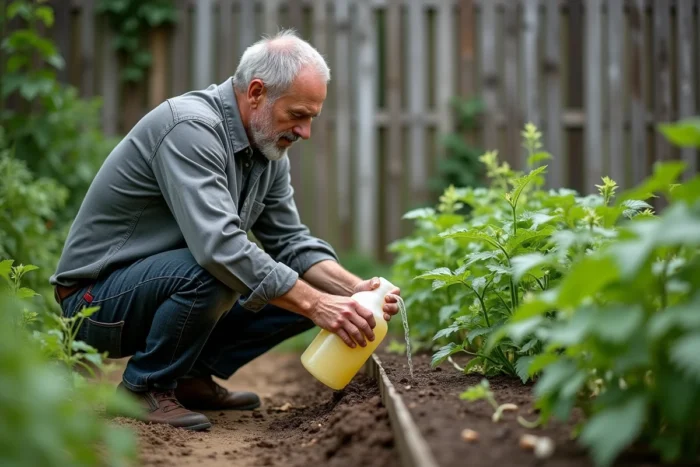
Preparation of Garlic Manure: Steps and Dilution Precautions
The preparation is based on a simple principle: to extract the active substances from garlic (allicin, sulfur compounds) through fermentation in water. The necessary equipment is limited to a non-metallic bucket, a filtration cloth, and an opaque storage container.
Concrete Steps
- Crush or finely chop the garlic cloves to maximize the surface area in contact with the water. The more fragmented the garlic, the more fermentation releases active compounds.
- Submerge the garlic in preferably rainwater (chlorinated tap water can hinder fermentation) and let it macerate for several days, stirring daily.
- Filter the mixture through a fine cloth to remove solid residues. These leftovers should not be discarded: they can serve as a compost activator or be incorporated at the base of trees.
- Store the filtrate in an airtight and opaque container at a moderate room temperature.
Dilution Before Spraying
Concentrated preparations must be diluted before spraying to avoid burning the leaves. Young plants and delicate subjects are particularly sensitive. Several gardening sources recommend testing the decoction on a small area before treating the entire foliage, to check the tolerance of each variety.
On tomatoes, for example, an overly concentrated application in full sun can cause leaf burn. It is better to spray in the evening or early morning when evaporation is slower.
Garlic Manure Against Aphids: Effective Alone or Just a Link in a Strategy
Garlic manure primarily acts as a repellent. Its sulfurous smell disturbs aphids and some insects, but it does not kill them on contact like an insecticide would. In the case of an already established infestation, spraying garlic alone is generally not enough to reverse the situation.
The most convincing results appear when garlic manure is part of a combined approach. The most detailed gardening content describes a progressive management strategy that combines several natural levers.
- Regular observation of plants to detect the first outbreaks before they become widespread.
- High-pressure water jets to mechanically dislodge already visible aphid colonies.
- Utilizing beneficial insects (ladybugs, hoverflies, lacewings) whose larvae consume significant amounts of aphids.
- Controlling ants, which protect aphids to harvest their honeydew and prevent natural predators from doing their job.
- Companion plants (nasturtiums, lavender) that attract or repel certain pests.
Garlic manure works better as a preventive treatment than as a curative one. Applied before the arrival of aphids, it reduces the attractiveness of the plants. When applied to a dense colony, its effect remains limited if other levers are not activated in parallel.
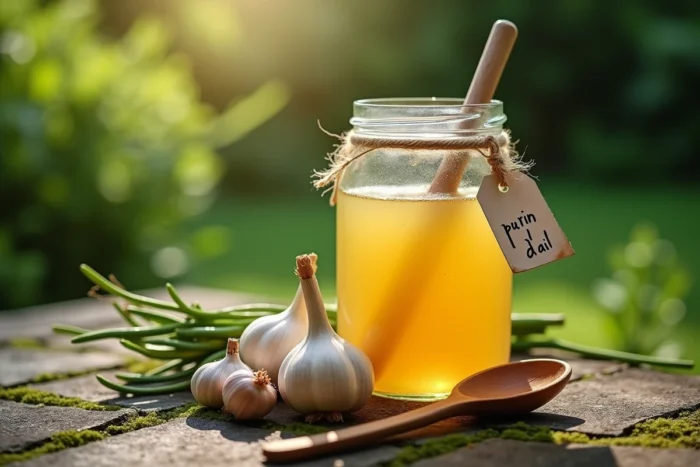
Storage of Garlic Manure and Known Limits of the Treatment
Properly filtered garlic manure stored in a closed container away from light can last several weeks. Beyond that, fermentation continues, and the product may lose effectiveness or become phytotoxic. There is no clear consensus on the maximum storage duration, as field reports vary depending on storage temperature and filtration quality.
Regarding limits, garlic manure has not been studied as extensively as other natural preparations like nettle manure or horsetail decoction. The available data does not allow for a conclusion on a universal optimal dosage. Each gardener adjusts based on their observations, making comparisons difficult.
The antifungal action sometimes attributed to garlic manure, particularly against tomato downy mildew, relies more on gardeners’ testimonies than on controlled results. However, its repellent effect on certain insects and small pests seems to be more documented in practical feedback.
When Garlic Manure Is Useless
It would be counterproductive to present garlic manure as a universal solution. In the face of a massive aphid attack, an advanced fungal disease, or underground pests, this preparation does not yield significant results when used in isolation.
A one-time natural treatment does not replace a comprehensive strategy that starts with soil health, plant diversity, and the presence of beneficial organisms. Garlic manure finds its place as a complementary tool in this palette, not as a miracle solution applied in an emergency.
The gardener who achieves the best results with this type of preparation is the one who integrates it into a regular preventive routine, combined with careful observation of their vegetable garden. Without this framework, garlic maceration remains a symbolic gesture rather than an effective treatment.