
A high direct view poses a different problem than a simple lateral glance between neighbors. When the view comes from a building, a rooftop terrace, or an elevated floor, classic solutions (low fences, hedges trimmed to eye level) are not sufficient. The difficulty lies as much in local regulatory constraints as in the technical choice itself, as an installation that is too high or poorly positioned can lead to disputes or non-compliance with the local urban planning rules (PLU).
Regulatory height of fences: what the PLU changes concretely
Most guides suggest installing a privacy screen or a fence without mentioning the local legal framework. The reflex to install a two-meter-fifty high screening panel can, however, pose problems depending on the municipality.
There is no single maximum height at the national level for fences. It is primarily the rules of the Local Urban Planning Plan (PLU) that set the constraints. In the absence of a PLU or municipal regulations, Article 663 of the Civil Code applies, with thresholds varying according to the size of the municipality.
A point often overlooked: a fence placed on a low wall counts towards the total height. The measurement is taken from the natural ground to the top of the installation, including the low wall. A privacy screen of one meter eighty fixed on a one-meter low wall can therefore exceed the authorized threshold. Before investing in a high solution, the first step is to consult the urban planning department of the town hall to know the applicable limits for one’s plot.
To protect oneself from a high direct view, it is necessary to start from the regulatory framework before choosing the material or type of installation.
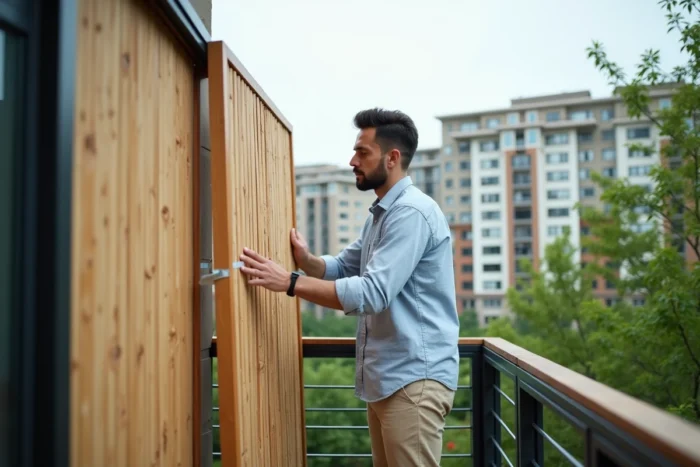
Wood, composite, or aluminum panels: which material against a downward view
When the view comes from above, the density of the panel is as important as its height. A slatted screen that works against a frontal view allows a downward view through its inclined slats.
Adjustable aluminum slats
Panels with adjustable aluminum slats allow for modulation of the angle of screening. Unlike fixed slats, they adapt to the direction of the intrusive view. This is the most technical solution, but also the most expensive. It is especially justified when the view comes from a specific point (building window, elevated terrace) and one wishes to maintain natural light.
Solid wood or composite panels
A solid panel made of wood or composite offers total screening. Composite material withstands the elements better and does not require regular treatment; however, it is more expensive to purchase. Wood (treated pine, douglas) remains the most common choice for high fences but requires maintenance every two to three years to prevent graying.
In both cases, the fastening must support the weight and wind resistance of a tall panel. Ground anchoring with posts set in concrete is preferable to a simple plate fixing, especially beyond two meters of total height.
Vegetation solutions against a high direct view: regulatory and practical limits
Plants are often presented as a simple and natural response. The reality is more nuanced when it comes to blocking a downward view.
Hedges and trees are also legally regulated. The rules for planting distances vary depending on whether the vegetation exceeds two meters in height, and can be reinforced by municipal regulations. Planting a large-growing tree too close to the property line exposes one to a request for pruning or even removal.
A point that competitors rarely address: a plant planted in the ground does not follow the same rules as a pot placed on a terrace. A tree planted in the ground near the boundary is subject to the planting distances of the Civil Code. A mobile pot on a terrace is not subject to these same provisions, which opens up different possibilities for balconies and upper terraces.
Dense or evergreen trees
To block a view coming from above, dense foliage on the entire upper part of the tree is needed. Columnar species (Italian cypress, fastigiate hornbeam) grow tall without spreading. Evergreen species retain their coverage in winter, which prevents being exposed for six months a year.
Field reports vary on this point: a fast-growing evergreen tree (photinia, laurel) may take several years to reach a sufficient height to block a view from an upper floor.
Climbing plants on a tall structure
An alternative is to install a vertical structure (trellis, tensioned cables, pergola) and let plants climb on it. Star jasmine, clematis armandii, or ivy can cover a vertical surface in a few seasons. This solution works particularly well on terraces where the ground is not available.
- Check the load-bearing capacity of the structure before planting: an adult climbing plant can be heavy, especially after rain
- Plan an appropriate watering system for pots on terraces, where the substrate dries out faster than in the ground
- Prefer evergreen species if the goal is year-round screening
Films and glazing for windows exposed to a downward view
When the direct view concerns the windows of a dwelling, external solutions are not always sufficient. Adhesive films for glazing offer a quick and reversible response.
A frosted or opaque film allows light to enter while eliminating transparency. There are mirror-effect films that reflect the view from the outside, but their effectiveness decreases significantly at night when the interior lighting is on. Micro-perforated films, used for ground-floor bay windows, are less suitable for a high direct view because the downward gaze passes through the micro-perforation.
Opaque glazing or frosted glass remains the most durable solution for a fixed window (bathroom, hallway). For living spaces where the outside view matters, a venetian blind with adjustable slats offers a compromise between privacy and light, with fine adjustment of the screening angle.
The choice between external solutions and glazing treatment primarily depends on the location of the direct view. A downward gaze on a terrace calls for a response in the garden. A gaze on a bedroom window is more effectively addressed from the glazing side. In both cases, checking the local regulatory framework before installing anything high remains the precaution that avoids unpleasant surprises.