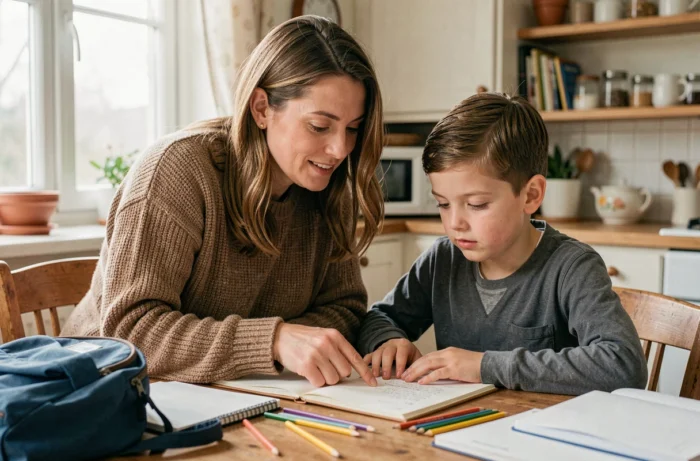
Supporting a child’s education is not just about checking their homework in the evening. The term encompasses a set of regular actions (work organization, regulation of school-related emotions, dialogue with the teaching team) that, when combined, create the conditions for sustainable learning. Many of these actions are misunderstood or underestimated by families, even though public and associative support systems exist to assist them.
Metacognition and academic autonomy: learning to learn before helping with homework
Most advice for parents focuses on homework time. The problem lies upstream: a child who does not know how they learn cannot work independently, regardless of the framework established at home.
Metacognition refers to the ability to observe one’s own learning processes. Specifically, this means that a child identifies whether they retain information better by reading, writing, or reformulating aloud, and adjusts their method according to the subject matter.
A parent can foster this skill without specific pedagogical knowledge. After a study session, two questions are sufficient: “What did you find difficult?” and “How did you manage to get through it?”. These questions shift the focus from the result to the process. The child gradually learns to diagnose their blockages rather than waiting for external correction.
Digital resources allow for extending this work. On clic-et-moi.fr, families access tools that facilitate the search for educational activities suitable for each age group, complementing daily parental support.

Work organization at home: rituals and management of school time
The organization of homework relies less on the duration spent than on regularity and predictability. A fixed time slot each day, even if short, yields better results than a long session on the weekend.
Structuring a space and a ritual
A dedicated space, even modest, reduces the time taken to get to work. Clear table, materials ready, phone out of reach. The associated ritual (snack, then work, then free time) allows the child to switch into a focused mode without daily negotiation.
A common trap is to multiply extracurricular activities to the point of leaving no stable time slot for personal work. When the weekly agenda constantly changes, the child loses their bearings and ability to anticipate the workload.
Breaking tasks into shorter sessions rather than extending them
The capacity for concentration varies by age. In primary school, sessions of fifteen to twenty minutes are realistic. In middle school, thirty minutes remains an effective ceiling before a short break. Two short sessions are better than one continuous hour without a break. Alternating subjects (a writing task followed by a math exercise) keeps attention longer than a homogeneous block.
Emotions and schooling: identifying school stress before it settles in
Academic difficulties are rarely purely cognitive. Anxiety related to assessments, fear of disappointing, or feelings of incompetence hinder learning as much as a lack of knowledge.
A child who says “I’m bad at math” is not expressing a diagnosis; they are conveying an emotion. Correcting the belief without acknowledging the emotion is ineffective. Naming the emotion before proposing a technical solution changes the dynamic: “You seem discouraged, what exactly happened?” opens a space for dialogue that “No, you’re not bad, redo the exercise” immediately closes.
Some signals deserve particular attention:
- Recurring stomach or head aches on school days, without identified medical causes, often indicate tension related to the school context.
- A child who stops talking about school spontaneously when they used to do so may be in a phase of emotional withdrawal.
- A sudden drop in results in a single subject points more towards a relational problem (with a teacher or a peer) than a lack of effort.
When these signals persist, seeking help from the school psychologist or the national education doctor remains a free and confidential approach, still too little used by families.
Free educational support programs: CLAS, mentoring, and homework assistance
Daily support no longer relies solely on parents. A network of public and associative programs has been structured in recent years, and most families are only aware of a fraction of them.
- The Local Contract for Educational Support (CLAS), funded by Caf, offers a framework outside of school hours that combines homework help and educational activities. It explicitly aims to reduce inequalities in access to knowledge.
- The “Devoirs faits” program, integrated into middle schools, provides free assistance time supervised by teachers or educational assistants.
- AFEV, a student mentoring association, has supported over 20,000 young people in the 2024-2025 year. The principle: a volunteer student follows a child throughout the year, with regular in-person or video conference sessions.
- ZUPdeCO offers a hybrid model (in-person and online) that adapts to the geographical constraints of families living far from urban centers.
These programs do not replace the parental role, but they fill a gap when parents lack the time or disciplinary skills to support a child in certain subjects. Inquire with your local municipality or Caf to learn about accessible solutions in your community.
Artificial intelligence and homework: a tool under conditions
Generative AI has become a homework assistance tool that most parents now accept, under certain conditions. This rapid acceptance raises a simple educational question: does AI help the child understand or does it provide an answer that they copy?
The difference lies in the use. Asking an AI assistant to explain a theorem step by step is part of learning. Asking it to write an essay is a form of delegation. Parents who supervise this use generally establish a clear rule: AI is used to understand, not to produce the final output.
Checking the generated answers remains a habit to instill early. AI tools regularly produce factual errors, and learning to spot them constitutes a critical thinking exercise useful well beyond the school context.
Supporting education benefits from combining these different levers, from daily rituals to external programs, while paying genuine attention to the child’s emotions. No single recipe works for all profiles, but consistency in focusing on the learning process, rather than just grades, remains the most reliable guiding principle.


