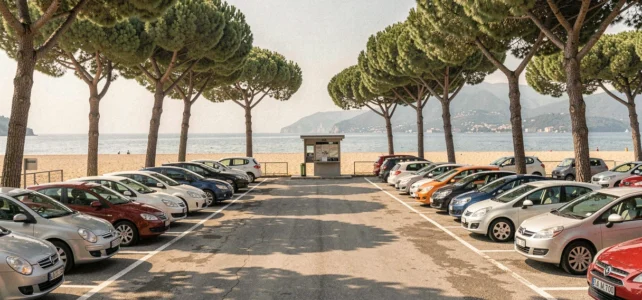
The Pisa coastline is not limited to the Piazza dei Miracoli. The beaches accessible by car from the city center are spread across several coastal towns, each with its own parking rules. Comparing parking near the beach in Pisa involves considering three variables: proximity to the sand, cost during peak season, and the risk of fines related to regulated zones. This article measures these factors, station by station.
Comparison of parking beach by beach on the Pisa coastline
The three main seaside resorts (Marina di Pisa, Tirrenia, Calambrone) are all about a twenty-minute drive from the center of Pisa. Their parking offerings differ significantly.
| Seaside resort | Dominant parking type | Distance to sand | Pressure in peak season |
|---|---|---|---|
| Marina di Pisa | Blue lines (paid) along the lungomare, rare white lines (free) | Immediate (facing the sea, Via Litoranea) | Very high |
| Tirrenia | Structured parking linked to beach establishments | A few minutes on foot | High |
| Calambrone | Less tense parking, roadside spaces | Variable depending on the area | Moderate |
The parking guide for Marina di Pisa lists spots at 8 Via Litoranea, directly facing the sea. This is the only point on the Pisa coastline where parking is actually adjacent to the beach without an intermediate step.
To know exactly where to park near the beach in Pisa, one must distinguish the color zoning of Marina di Pisa from the structured parking of Tirrenia, which operates under a completely different logic.
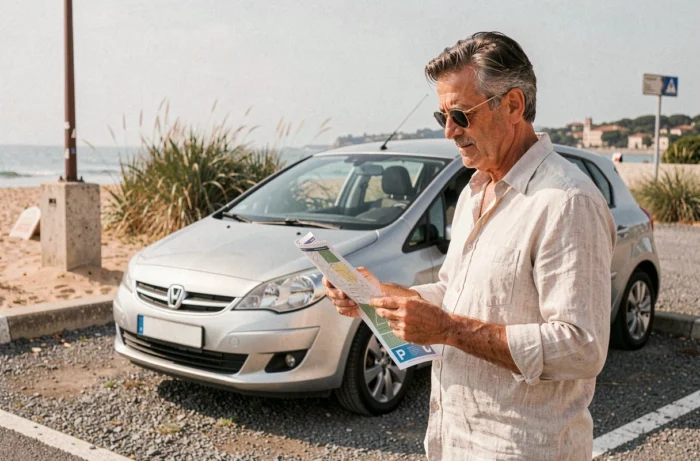
Color zoning in Marina di Pisa: white lines, blue lines, and fine traps
Marina di Pisa uses a color code painted on the ground to regulate parking. White lines indicate free spaces, but they become scarce at the beginning of summer. Blue lines, which are paid, line the lungomare and the streets perpendicular to the coast.
The most common trap concerns spaces reserved for residents. These spots, sometimes indicated only by a sign in Italian, attract hurried drivers who do not read the local signage. A fine in a resident zone costs significantly more than a parking meter.
Two reflexes can help avoid unpleasant surprises:
- Check the color of the line on the ground before turning off the engine. White = free, blue = paid, yellow = reserved (residents, disabled, deliveries)
- Read the detailed sign associated with each blue zone, as paid hours vary by street and time of year
- Arrive before mid-morning in July and August, as free white lines are taken from the early hours
In contrast, in Calambrone, the last station before Livorno, the pressure on parking remains significantly lower. Visitors willing to drive a few more minutes find spaces without difficulty, even in the height of summer.
Park-and-ride and shuttle to the beaches: an underestimated alternative
Several parking guides recommend an approach that most visitors overlook: parking in a peripheral lot and reaching the coast by shuttle. The LAM Rossa line connects the center of Pisa to the seaside resorts along the coast and is the central link in this strategy.
The principle is simple. Leave the car in a parking lot in Pisa city (via Pietrasantina, for example), then take the shuttle to Marina di Pisa or Tirrenia. The journey takes about twenty minutes.
What park-and-ride changes concretely
Parking in the city costs less than on the waterfront. The vehicle remains in a monitored area rather than on an exposed coastal parking lot. And above all, the return at the end of the day no longer depends on a parking meter whose ticket expires at 6 PM.
This option is particularly suitable for families loaded with beach gear, as the shuttle drops passengers very close to the sand. The travel time more than compensates for the twenty minutes of walking that a distant parking lot imposes in Marina di Pisa during peak season.
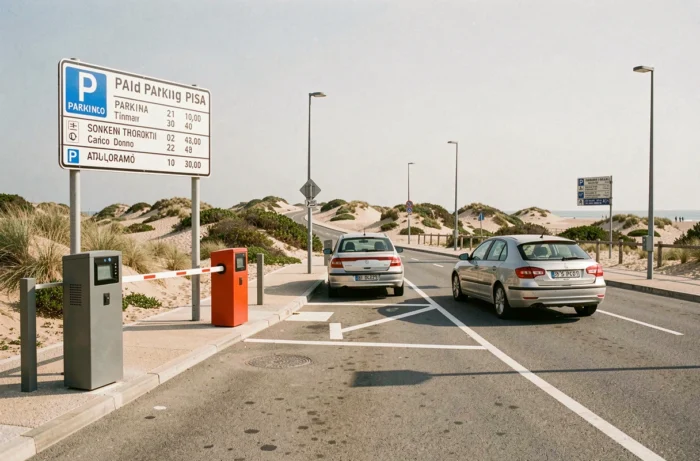
Private beaches and parking: the constraint that parking lots do not solve
A parameter rarely addressed in parking guides changes the entire equation: a large part of the Tuscan coastline is privatized in summer. Easy parking does not guarantee free access to the sand.
In Tirrenia, structured parking is often attached to beach establishments (stabilimenti). Parking there is sometimes conditioned on renting a sunbed or an umbrella. This means that the actual cost of a day at the beach includes parking and access to the stabilimento.
In Marina di Vecchiano, access is regulated by the Migliarino-San Rossore-Massaciuccoli natural park. The number of vehicles allowed is limited, and spaces fill up early. This is not a parking problem in the traditional sense, but a regulated access constraint that makes planning essential.
Vecchiano: a special case on the Pisa coastline
The beach of Vecchiano offers a preserved natural setting, without private stabilimenti. The trade-off is a more restrictive access logistics than at other resorts. Parking is controlled, the number of spaces is capped, and arriving late in summer often means a complete refusal of access.
For visitors who prioritize tranquility and natural surroundings over ease of access, Vecchiano justifies the constraint. For those seeking easy parking, Marina di Pisa and Calambrone remain the most reliable options on the Pisa coastline.