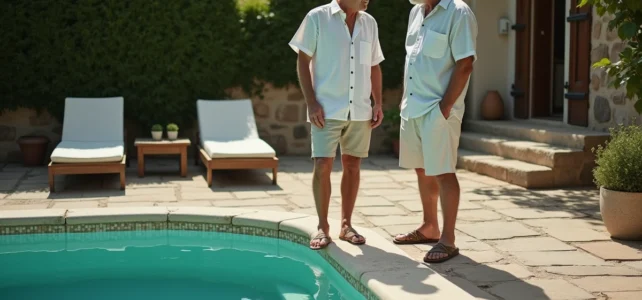
A concrete pool from the 90s that is losing water, a discolored liner, a filtration system running dry: we often find ourselves facing a binary choice perceived as “tear it all down or keep it all.” The reality on the ground is more nuanced. Several targeted interventions allow for a deep renovation of your pool without demolishing the existing structure or redoing the surroundings.
Raising the pool bottom: reducing volume without touching the structure
Many pools dug in the 80s and 90s still exist with depths of two meters or more, designed for diving. In practice, a family with children or senior owners never uses this depth.
Raising the bottom involves pouring a slab or installing a formwork in the existing pool to raise the ground level. The volume of water decreases, along with the heating needs, chemical treatment, and filtration time. It is a partial transformation that preserves the original shell, the coping, and the peripheral pipes.
Several pool professionals now offer this intervention as standard during major renovation projects. The raising can be combined with a change of lining to start fresh on a healthy base, without digging or altering the footprint. Feedback on the final comfort varies depending on the pool’s configuration, but the savings on water consumption are consistent.
For those looking for a pool alternative on Univers du Bricolage, raising the bottom is one of the least invasive solutions to consider before any demolition.
Polyester shell in an old concrete pool: heavy renovation without destruction
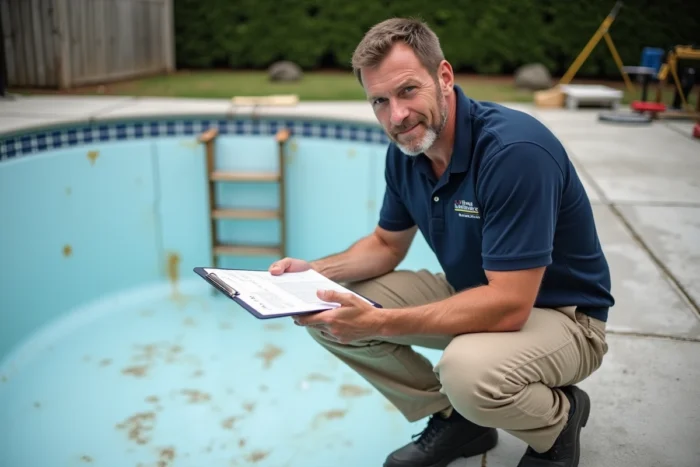
A cracked concrete pool or one with deteriorating plaster presents a real dilemma. Re-sealing is expensive, and the result depends on the condition of the support. For a few years now, a practice has been developing: installing a monobloc polyester shell inside the old pool.
The principle is simple. The pool is emptied, dimensions are adjusted if necessary (sometimes slightly reducing the usable surface), and then the shell is lowered into the existing structure. The surroundings, terrace, and technical room remain in place.
Limitations to know before getting started
This solution does not work on all pools. The geometry of the old pool must be compatible with the standard dimensions of the available shells. A free-form pool or one with atypical angles complicates the installation significantly.
It is also necessary to check that the remaining concrete structure can support the weight and hydrostatic pressure. A prior diagnosis by a professional is essential. Despite these constraints, the shell in the existing pool avoids complete earthworks and significantly reduces the duration of the project.
Coating and filtration: the two areas that change everything without major work
When the pool structure is sound, there is no need to touch the civil engineering. Two interventions are enough to transform the use and aesthetics of an aging pool.
Change the lining without modifying the pool
The choice of lining depends on the support and budget, but the most common options for a renovation without breaking are:
- The reinforced liner (reinforced PVC membrane), installed directly on the existing support after preparation, which offers independent waterproofing from the structure
- The silico-marble coating, applicable on concrete or gunite, which gives a mineral appearance and superior durability compared to a classic liner
- The polyester waterproofing resin, a more technical solution that treats micro-cracks while creating a durable waterproof layer
The reinforced liner remains the most common choice in renovation because it adapts to most pool shapes and compensates for small irregularities in the support.
Modernize the filtration without rebuilding the technical room
A pump that is over ten years old often consumes much more than a recent model with equivalent flow. Replacing the pump with a variable speed model significantly reduces electricity consumption without modifying the hydraulic network.
Beyond the pump, the filtering medium can also be reconsidered:
- Switching from classic sand to filter glass, which offers superior filtration fineness and clogs less quickly
- Installing a large-format cartridge filtration system, which eliminates the need for backwashing and thus the associated water waste
- Adding a salt electrolyzer to reduce the use of liquid chlorine and simplify regular maintenance
Changing the filtration and the lining at the same time allows for consolidating the intervention into a single draining of the pool, which limits labor costs and the duration of unavailability.
Ecological pool: transforming a traditional pool into a natural swimming area
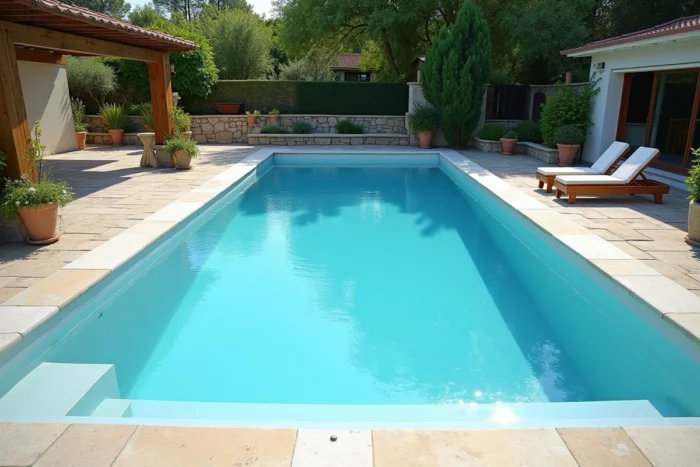
Some owners no longer want to manage chlorine, chemicals, and the energy consumption of a traditional pool. Rather than destroying the pool to create a natural basin from scratch, one can convert the existing pool into an ecological pool by adding an adjacent lagoon area.
The swimming area remains in place. A compartment planted with filtering plants is created next to (or around, depending on the available space) to ensure the biological purification of the water. The existing pump can sometimes be retained to ensure circulation between the two areas.
This conversion requires additional space and precise sizing of the lagoon relative to the volume of the pool. The result eliminates the need for treatment product purchases and radically transforms the garden’s aesthetics, but plant maintenance replaces chemical maintenance; it does not disappear.
Renovating a pool without changing everything relies on an honest diagnosis of what still works. A sound concrete structure does not justify demolition. A tired filtration system does not condemn the pool. Identifying the right area for intervention, whether it be the bottom, the lining, the filtration, or the treatment method, allows for extending the lifespan of the pool for many years, with a budget and impact much lower than a complete reconstruction.